Why Legitimacy, Not Precision, Determines Conservation Outcomes
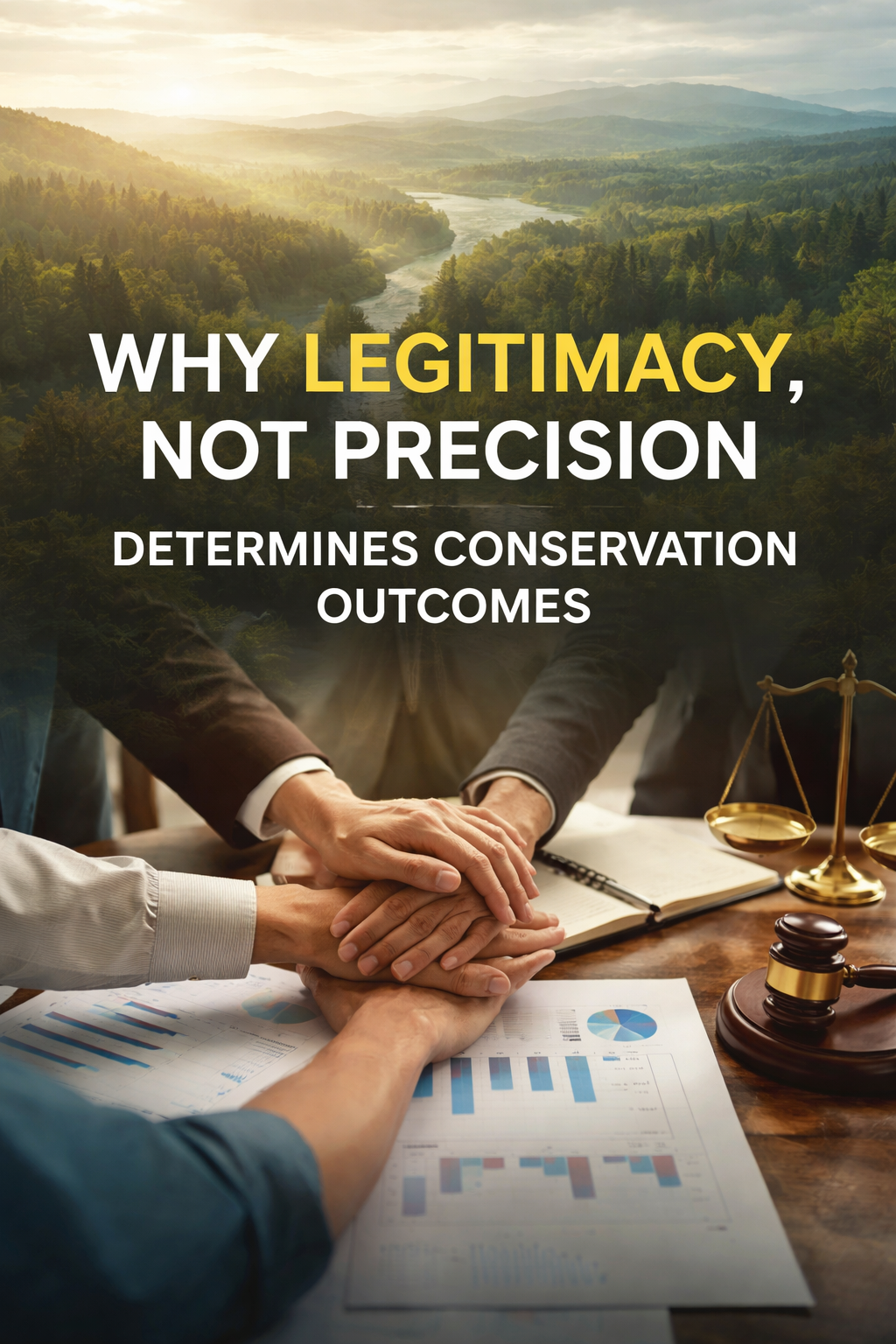
Legitimacy is a structural constraint
Legitimacy is often treated as something to address after priorities are set—through consultation, outreach, or messaging.
At scale, that framing breaks down.
Without legitimacy:
agreements unravel when conditions change
implementation slows or stalls under conflict
trust erodes between institutions and communities
compliance becomes contingent rather than durable
No amount of technical precision can compensate for decision processes that people do not recognize as fair, inclusive, or accountable.
Legitimacy is not a social add-on. It is a structural condition for conservation to persist at scale.
Governance is how legitimacy is carried
Governance, in this context, is not about bureaucracy or control. It is about how decisions are made, contested, and sustained under complexity.
At large landscape scales, governance systems must explicitly answer questions such as:
who has standing to participate
how conflicts are addressed when values collide
how authority is exercised across overlapping mandates
how decisions remain valid as conditions change
These questions are unavoidable. Ignoring them does not make conservation more efficient; it makes it more fragile.
This is why conservation outcomes increasingly hinge not on optimization, but on whether decision systems are capable of carrying legitimacy over time.
Why this matters now
As conservation requirements expand, tolerance for brittle solutions shrinks.
Efforts built primarily around technical precision may succeed briefly, but they often struggle to adapt, persist, or scale. Over time, this pattern erodes not just individual projects, but confidence in conservation itself.
If conservation is to operate at the scale the moment demands, it must be grounded in legitimate, resilient governance, not simply better analysis.
That constraint—more than data, more than tools—is now decisive.
Stay connected
This website is the canonical home for Designing Nature’s Half and the place where these questions are examined in depth.
If legitimacy and large-scale decision-making are challenges you face in practice, you can join the email list to receive future essays as the work develops.
Join the email list to stay connected.
You’ll hear from me only when the work meaningfully advances.