
Designing Nature’s Half:
An Architecture for Conserving 50% by 2050
Turning the 50×50 vision into landscape-scale reality.
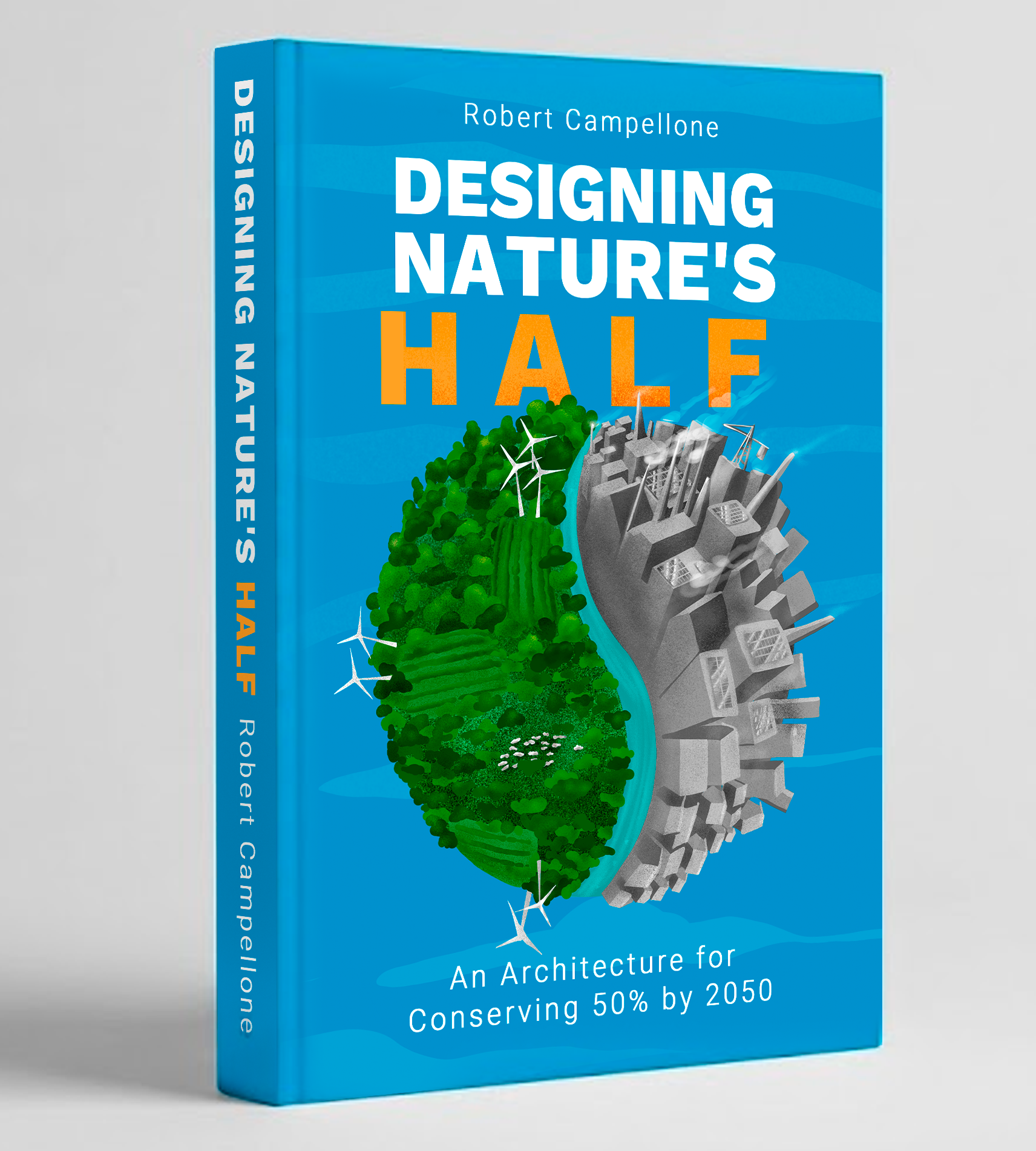
The book examines what it would take to conserve half of Earth’s lands and waters by mid-century—not as a slogan or moral appeal, but as a design and governance problem. It situates this question within the context of the triple planetary crisis of pollution, climate change, and biodiversity loss, and considers how conservation strategies can function amid competing land uses, fragmented authority, and uncertainty
What This Book Is About
Designing Nature’s Half: An Architecture for Conserving 50% by 2050 is a science-based book that examines how conserving 50% of lands and waters can be intentionally designed and governed to sustain biodiversity, ecological function, and human well-being. Rather than prescribing policies or offering a procedural manual, the book clarifies the decision architecture of large-scale conservation—how authority must be structured, commitments made durable, and collaboration configured so that scientifically robust and socially legitimate designs endure over time.
What Makes This Book Different?
Drawing on decades of applied conservation and policy experience, Designing Nature’s Half: An Architecture for Conserving 50% by 2050 examines one of the most consequential conservation challenges facing the United States today: the interlinked problem of pollution, climate change, and biodiversity loss—often described as the triple planetary crisis. The book reflects the perspective of Robert Campellone, a former Senior Policy Advisor for the U.S. Fish and Wildlife Service, National Wildlife Refuge System, whose work has focused on translating conservation science into large-scale planning and decision-making frameworks. Rather than framing this challenge as a call to action, the book approaches it as a design problem shaped by ecological limits, institutional complexity, and competing land uses, situating today’s conservation landscape within a longer lineage of environmental reckoning in the United States.
This book does not argue that conserving half the planet is inevitable or easy. Instead, it asks what deliberate, science-informed design would require if such a goal is to be approached with credibility and durability.
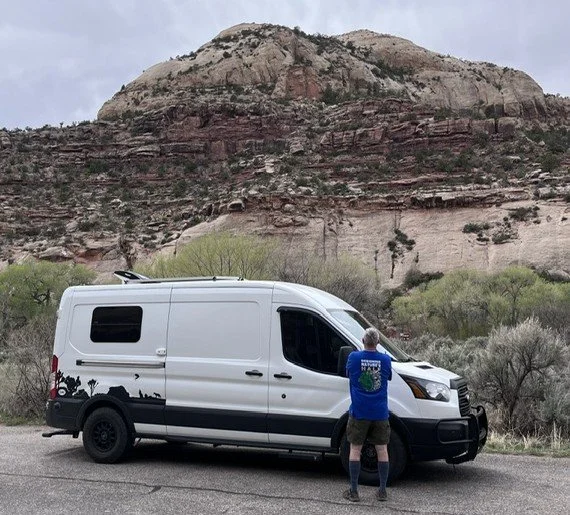
The author with CAV - the Camp Alone Van - at Bears Ears National Monument, Utah
For much of the past century, conservation has focused on protecting individual places: parks, refuges, reserves, and other bounded areas set aside from surrounding development. These efforts have produced important gains. Yet they have not been sufficient to halt accelerating biodiversity loss or to sustain ecological processes at the scales demanded by climate change. A growing body of science now points toward a different conclusion: meaningful conservation requires planning and action at the scale of entire landscapes.
Who Is This Book For?
The primary audience consists of professionals who work directly with land, ecosystems, and conservation decision-making at large landscape scales. This includes:
• Conservation practitioners • Landscape ecologists and applied scientists • Conservation planners and designers • Land and resource managers • Interdisciplinary assessment teams • Senior technical staff in conservation organizations • Decision-makers responsible for spatial, ecological, or long-term conservation outcomes.
The secondary audience includes readers who interact with conservation practice but are not primary designers or implementers. This includes:
• Policy advisors and analysts • Interdisciplinary researchers adjacent to ecology • Advanced graduate students (professional or applied tracks) • Philanthropic or institutional program officers • Governance and planning professionals working with conservation teams.
Technical resourcesfor practitioners are available in our Technical FAQs and Infographic: LCD vs Planning.
Context & Origin

In recent years, the scale and pace of environmental change have become harder to ignore. According to the National Oceanic and Atmospheric Administration, global average temperatures in 2023 exceeded pre-industrial levels by approximately 1.35°C (2.4°F), making it the warmest year in the instrumental record. At the same time, biodiversity assessments continue to document widespread decline. In Biodiversity in Focus: United States Edition, NatureServe reported that more than one-third of assessed species and ecosystems in the United States are at risk.
These findings do not point to a single cause or a simple solution. Instead, they reflect the convergence of multiple pressures—climate change, land use, pollution, and fragmentation—operating across large spatial and temporal scales. Addressing such conditions requires approaches capable of working across boundaries, integrating science with governance, and adapting over time.
For the author, this context also marked a personal inflection point. After retiring from public service, the question became how to continue engaging with these challenges in a way that was constructive and grounded in experience. Writing Designing Nature’s Half: An Architecture for Conserving 50% by 2050 emerged as one response to that question: an effort to synthesize decades of applied conservation work into a practical examination of how large-scale conservation might be deliberately designed under contemporary conditions.
The book’s title echoes a sentiment once expressed by conservationist and writer Dave Foreman—that living on a biologically rich planet carries responsibilities as well as benefits. Here, that sentiment is translated not into exhortation, but into inquiry: what would it take, in practice, to approach ambitious conservation goals with rigor, transparency, and durability?