Every Book Has a Story: How Designing Nature's Half Came to Life
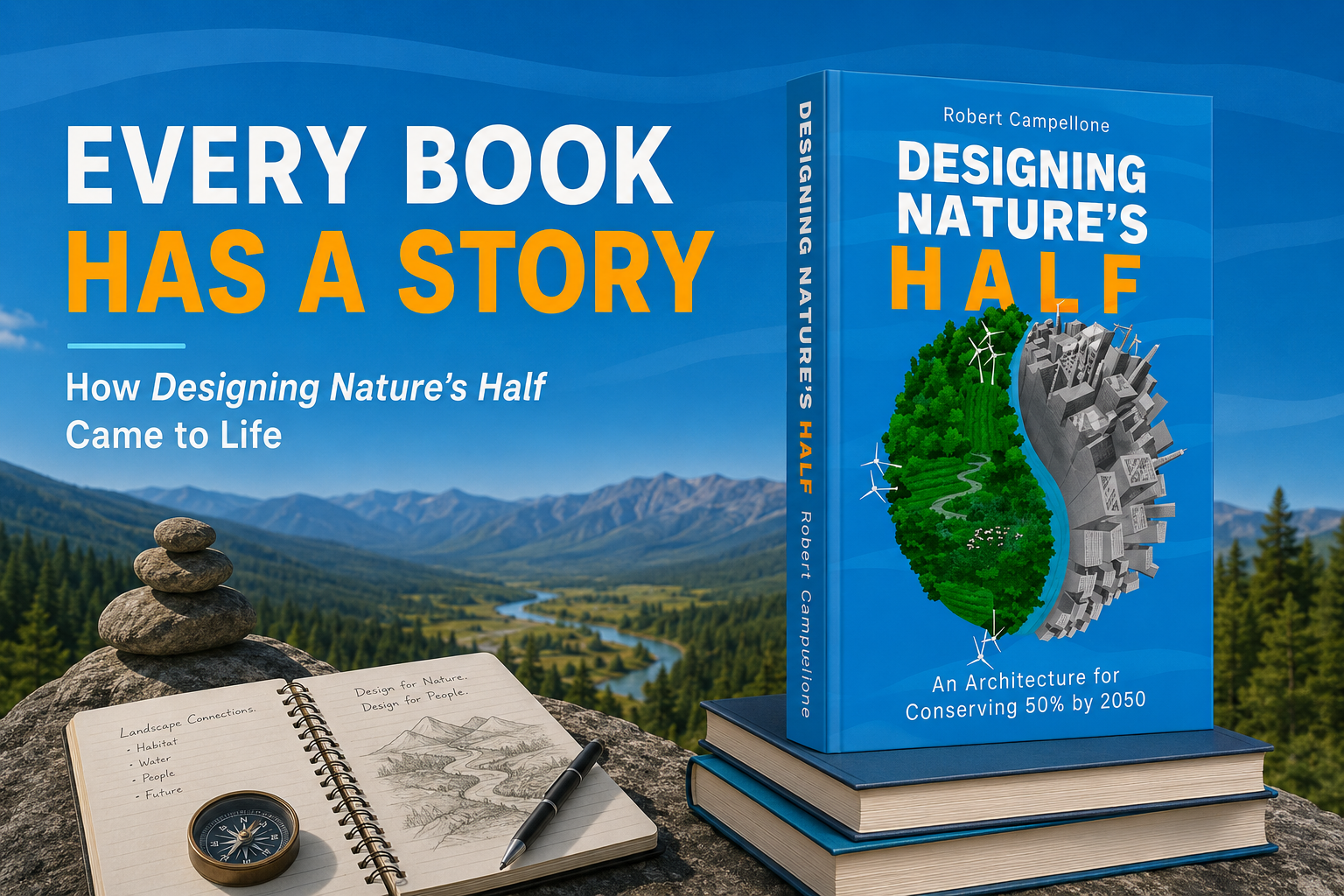
Every book has a story that begins long before its first chapter is written.
Designing Nature's Half: An Architecture for Conserving 50% by 2050 is no exception.
The ideas behind Designing Nature's Half took shape over more than twenty-five years of work in landscape conservation. They grew through conversations with colleagues, experiences across remarkable landscapes, difficult conservation challenges, and one enduring question that refused to go away:
How do we organize conservation at the scale of nature itself?
When the writing began in 2023, more than twenty-five years of ideas, conversations, and experience began taking the form of a book.
Completing the manuscript seemed like the finish line.
It wasn't.
It was the beginning of an entirely new journey.
Today, Designing Nature's Half is steadily transforming from a manuscript into a book, and watching that evolution unfold has been one of the most rewarding parts of the entire project.
Over the past several months, one milestone has followed another. The manuscript completed professional technical review, and those recommendations have been incorporated throughout the text. A second round of professional editing is now underway with Hunter McClure Editing. Dr. Charles Curtin, author of Place-Based Solutions: The Power of Regenerative Thinking in the Face of Crisis, Complex Ecology, and The Science of Open Spaces, has graciously contributed the book's Foreword. Graphic Designer Lucas Ghilardi has completed the book's figures and table, translating complex ideas into clear visual models. Longtime friends and colleagues Steve Markason and Dr. Ronald J. McCormick contributed their expertise in very different ways. Steve and the Teton Wildfire Mitigation Team generously provided GIS expertise and spatial analyses that illustrate several of the book's concepts, while Ron contributed beautiful landscape photographs that will appear throughout the book and remind us what these ideas ultimately seek to protect. Behind the scenes, a Kickstarter campaign has taken shape as well. The campaign video is complete, and we're now waiting for Kickstarter to approve the pre-launch page before sharing it publicly.
Each milestone has brought the book another step closer to publication.
Perhaps the most rewarding discovery of this journey has been realizing that the process of creating Designing Nature's Half became proof of one of its central ideas.
Throughout the manuscript, the book argues that our most complex conservation challenges cannot be solved by any single discipline, organization, or individual. Transformational conservation depends upon bringing together different forms of knowledge, experience, and expertise around a shared purpose.
The evolution of the book followed that very principle.
That collaboration began long before the manuscript entered professional technical review. During the early development of the project, my friend and colleague Tom Miewald joined me as a co-author as we explored ideas that eventually became the foundation of the book. Tom passed away in 2025, before he could see Designing Nature's Half reach this stage, but his influence remains woven throughout its pages, and I think of him often as the project approaches publication.
Tom and I also co-hosted Designing Nature's Half: The Landscape Conservation Podcast, where we had the privilege of interviewing many of the leading thinkers and practitioners shaping modern landscape conservation. Conversations with guests such as climate adaptation expert Doug Parsons, former National Wildlife Refuge System Chief Robin West, NatureServe ecologist Pat Comer, conservation scientist Hugh Possingham, and many others challenged assumptions, broadened perspectives, and helped shape the thinking that ultimately became this book.
Those conversations reinforced a lesson I've carried throughout my conservation career: our best ideas rarely emerge in isolation. They evolve through dialogue, respectful disagreement, and the generous exchange of knowledge and experience.
One of the most rewarding parts of this journey has been the manuscript's professional technical review. A diverse team of conservation professionals from across the field generously volunteered their time to evaluate the manuscript, challenge assumptions, identify weaknesses, and strengthen both the science and the practical application of its ideas. Their feedback has made the book more rigorous, more practical, and ultimately more useful to the conservation practitioners, organizations, and communities it was written to serve.
While I won't name every reviewer individually here, I hope each of them knows how deeply grateful I am for the time, expertise, honesty, and professional generosity they invested in this project. Every chapter is better because of their contributions.
Their fingerprints are throughout this book.
Looking back, one realization stands above all the others.
Although my name will appear on the cover, Designing Nature's Half has never really been the work of one person. It became a better book because so many people generously shared their knowledge, challenged its ideas, strengthened its science, improved its writing, clarified its illustrations, grounded its concepts, and reminded me—through words, images, and friendship—what this work is ultimately about.
A book that argues for collaboration has itself become a collaborative achievement.
The next stage of the journey begins in September.
The Kickstarter campaign will help fund the final stages of publication, including book design, printing, and fulfillment. More importantly, it will help launch Designing Nature's Half into the broader conservation community and begin building a network of readers committed to thinking differently about the future of landscape conservation.
Every book has a story.
This one began with a question.
Today, that question is becoming a book.