

International Day for Biological Diversity: From Land Protection to System Design
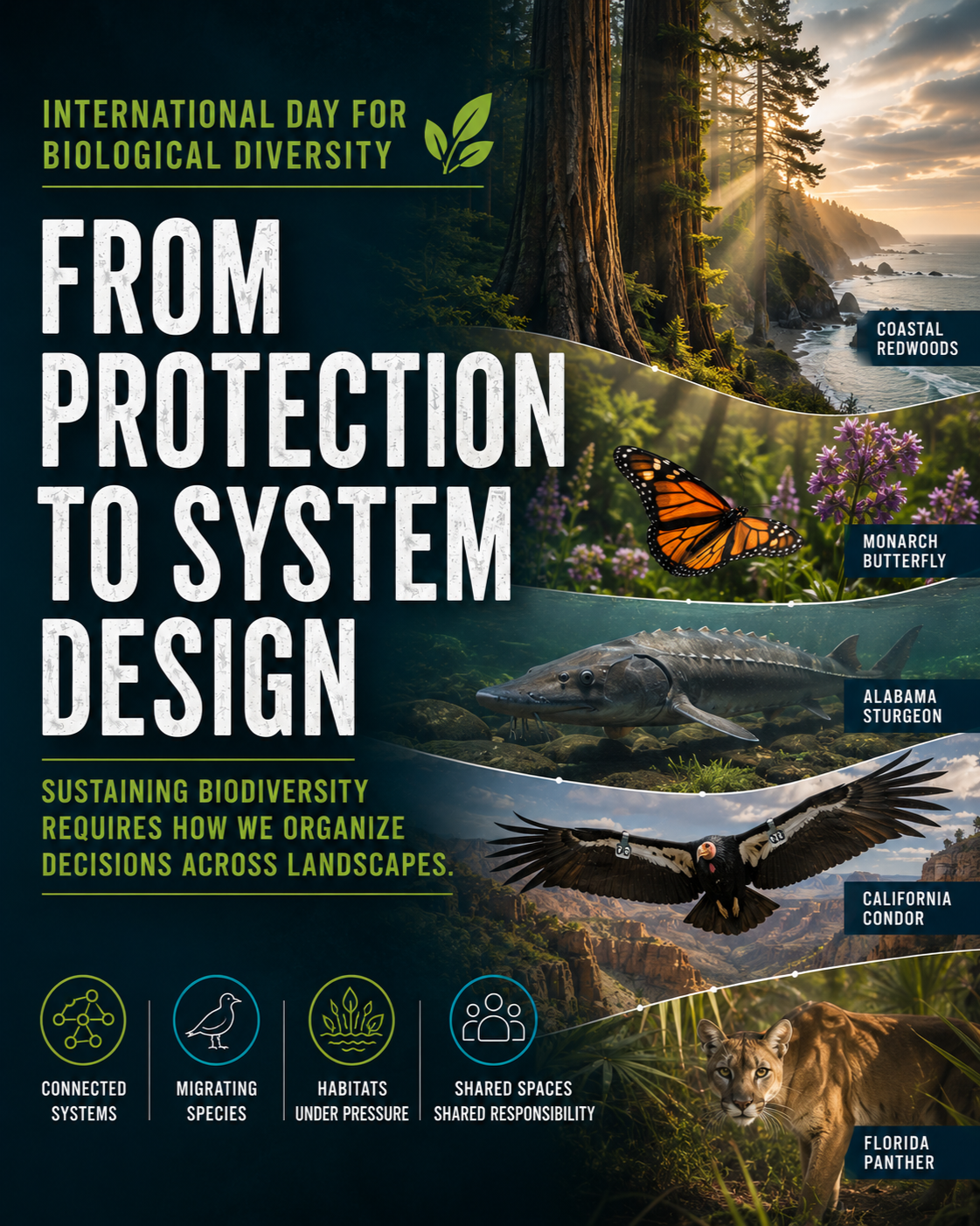
1. The International Day for Biological Diversity
The International Day for Biological Diversity represents more than a calendar date. It signifies global recognition that biological diversity is fundamental to ecological stability and human systems alike.
The observance is held on May 22 to commemorate the adoption of the Convention on Biological Diversity in Nairobi, one of the defining environmental agreements of the 1992 Earth Summit (Convention on Biological Diversity [CBD], n.d.). That international agreement, signed by 196 nations, helped establish biodiversity as a shared concern and recognized that biodiversity loss was tied to broader human and ecological systems (social-ecological systems).
That recognition remains relevant. Biological diversity continues to support food production, climate stability, and the ecological relationships that sustain life across landscapes (IPBES, 2019). What has changed is the growing recognition of how ecological systems, human pressures on them, and conservation and development decisions interact.
May 22 serves as more than a commemoration; it is a reminder that biodiversity has long been recognized as a global priority. The central question now concerns how conservation should be organized to sustain biodiversity under contemporary social-ecological conditions.
2. The Current State of Biological Diversity
The current state of biological diversity demonstrates increasing ecological pressure across interconnected systems. Species decline and ecosystem degradation are now recognized as pressures that interact across broader landscapes and the human systems linked to them.
Global assessments estimate that one million species remain threatened with extinction, while human activity has already altered 75% of the world’s terrestrial and marine environments (IPBES, 2019). Driven by expanding human influence, these pressures interact across ecosystems and accumulate over time. Biodiversity decline, therefore, signifies more than environmental loss. It reveals increasing pressure across social-ecological systems that conservation must respond to.
3. Conservation Has Not Been Absent
Conservation has played a significant role in efforts to sustain biological diversity. International agreements and national efforts to expand protected areas, in combination with habitat restoration and species recovery, have strengthened biodiversity conservation and improved coordination efforts globally (CBD, n.d.).
These efforts are significant. They have established biodiversity as a long-term, global priority, enhanced ecological understanding, and conserved biodiversity. Frameworks such as the Convention on Biological Diversity and the Kunming-Montreal Global Biodiversity Framework demonstrate increasing recognition that biodiversity requires coordinated action across ecological and political boundaries (CBD, n.d.).
Yet biodiversity decline continues.
Conservation systems now encounter a deeper structural challenge: sustaining biological diversity across landscapes under prolonged social and ecological pressure.
4. Where the Gap Remains
A deep structural challenge remains in how conservation is organized.
Biological diversity depends on connected social-ecological systems, yet many decisions affecting those systems remain fragmented across space and time, sectors, and jurisdictions. Land use decisions made in one place can shape ecological conditions within and across the larger system.
Under these conditions, conservation decisions may be effective at local scales but fail at broader ecological levels. This gap highlights a mismatch between the functioning of biological systems and the fragmented manner in which many conservation decisions are currently made.
Sustaining biodiversity depends on the organization and implementation of decisions across the systems they influence. Consequently, conservation must operate at larger geographic (i.e., landscape) scales where conservation challenges are more pronounced.
5. From Land Protection to System Design
Land protection remains fundamental to the conservation of biological diversity. International and national-level coordination, protected areas, restoration, and species recovery are all critical components of conservation practice.
Landscapes, however, are influenced by human decisions and ecological conditions that typically extend beyond the scope of existing conservation work. This realization raises a broader conservation question: sustaining biodiversity depends on conservation systems that can make decisions across social-ecological systems at an ecological scale.
This shift directs conservation toward system design, emphasizing the organization of decision-making across landscapes to sustain biodiversity more coherently. Such an approach reflects how conservation is adapting to the scale and interconnectedness of the systems upon which biodiversity depends.
6. What Biodiversity Requires Next
Effective and efficient conservation of biological diversity increasingly depends on the organization of our work across the systems they aim to support. This necessitates integrated decision systems capable of a diversity of stakeholders’ conservation work across landscapes, temporal scales, and sectors. Biodiversity relies on ecological relationships that extend beyond individual locations, while the pressures influencing these relationships often accumulate across broader social-ecological systems.
Conservation now increasingly relies on decision-making systems that can operate at ecological scales and maintain continuity over extended periods. This approach does not necessitate replacing existing site or species-specific efforts, but rather organizing them more coherently around the systems upon which biodiversity depends.
As biodiversity loss exposes the limitations of fragmented decision-making, the next era of conservation will depend on how effectively conservation systems can sustain social-ecological relationships under prolonged ecological change.
7. Why the Day Still Matters
The International Day for Biological Diversity represents more than a global observance. It signifies ongoing recognition that biodiversity remains fundamental to social-ecological systems and our long-term stewardship.
More than three decades after the Convention on Biological Diversity established biodiversity as a shared global priority, this responsibility has become increasingly evident. Biological diversity depends on interconnected social-ecological systems, while the pressures affecting these systems continue to interact across landscapes and over time.
This reality broadens the scope of conservation. Sustaining biodiversity increasingly depends on the effectiveness of conservation systems in making multi-jurisdictional and multi-sectoral decisions across the landscapes.
May 22 continues to represent more than a date of recognition. It serves as a reminder that sustaining biological diversity depends not only on the areas conservation protects, but also on how conservation is organized to sustain life across systems that extend beyond individual locations.
References
Convention on Biological Diversity (CBD). (n.d.). International Day for Biological Diversity. https://www.cbd.int
IPBES. (2019). Global assessment report on biodiversity and ecosystem services. Intergovernmental Science-Policy Platform on Biodiversity and Ecosystem Services. https://ipbes.net/global-assessment