

World Migratory Bird Day: What Migration Reveals About Conservation at Scale
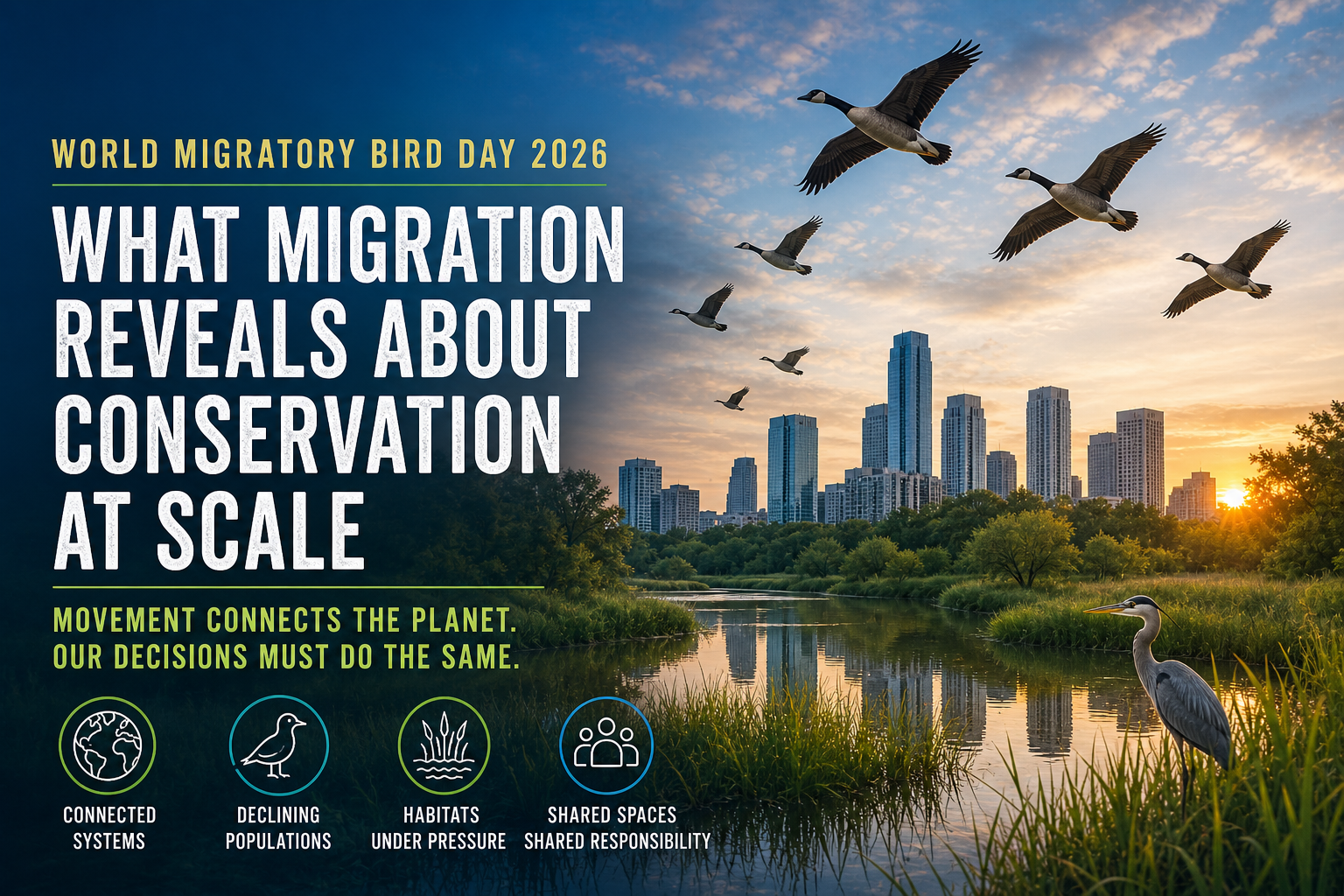
World Migratory Bird Day annually highlights migration as a prominent demonstration of ecological connectivity. In 2026, the observance falls on May 9, coinciding with spring migration in the Northern Hemisphere. Birds traverse continents, connecting wetlands, forests, coasts, and urban environments into an integrated ecological system. These movements are not merely symbolic; they exemplify how ecological processes function across distances, temporal scales, and the administrative boundaries established for human decision-making.
The 2026 theme, “Shared Spaces: Creating Bird-Friendly Cities and Communities,” signals an ongoing shift in conservation priorities. Conservation efforts now extend beyond remote habitats to encompass the design, governance, and management of human-dominated landscapes. Migration underscores the interconnectedness of these realities, demonstrating that inhabited areas are integral components of broader ecological systems.
Movement Across Scale
Migratory birds rely on a network of habitats distributed across vast regions. Breeding grounds, stopover sites, and wintering areas are interconnected through migratory movements. The failure of any segment within this network can disrupt the entire system. For example, draining a wetland, altering a coastline, or changing seasonal timing in one location can have cascading effects along the migration route.
These networks are commonly referred to as flyways, though the term does not fully capture their complexity. Flyways represent integrated social-ecological systems, influenced by both human decisions and ecological factors. The migratory routes intersect with agricultural areas, infrastructure, urban development, and conservation initiatives across numerous jurisdictions.
Migration demonstrates that ecological systems function at scales that exceed the scope of existing management and decision-making structures. The central issue is not the connectivity of these systems, but whether the decisions influencing them are similarly integrated.
Current Status
Migratory bird populations are declining across regions. Long-term monitoring shows widespread loss, including a decline of nearly 3 billion birds in North America since 1970 (Rosenberg et al., 2019). Global assessments indicate that roughly 44% of migratory species are in decline (Convention on Migratory Species [CMS], 2024).
These declines are not limited to specific regions or taxonomic groups. They are evident across multiple flyways, habitat types, and migration distances.
The causes are cumulative. Habitat loss, climate change, urbanization, and changes in land use all contribute to biodiversity loss broadly, including migratory birds (IPBES, 2019; Maxwell et al., 2016), but for migratory species, these pressures compound across the full migration cycle. Conditions encountered in one place shape outcomes in another. Degraded stopover sites reduce survival before birds reach breeding grounds. Shifts in seasonal timing disrupt access to food. Losses accumulate across regions and over time in ways that are difficult to reverse.
What the Data Shows
Extensive, long-term evidence supports these findings. In North America, population estimates are based on decades of monitoring, including breeding surveys, migration tracking, and large-scale observational datasets. These independent data sources consistently indicate that declines are both widespread and persistent.
Similar patterns appear in other regions. Monitoring across Europe shows that many long-distance migratory species are declining more rapidly than resident birds (Sanderson et al., 2006; Vickery et al., 2014). Flyway-specific studies document sharp population losses linked to habitat change at critical stopover sites, including coastal systems that support large portions of global populations (Studds et al., 2017). Global assessments synthesize these findings, showing that migratory species are disproportionately affected by environmental change (CMS, 2024).
The pattern is consistent: migratory bird populations are declining as the ecological systems they rely on are altered across regions and life-cycle stages (IPBES, 2019; Vermunt et al., 2020).
What Migration Reveals
Migration highlights a structural challenge in conservation systems. While birds traverse interconnected ecological systems, decisions impacting these systems are often made independently across jurisdictions, sectors, and timeframes. This results in a fundamental mismatch between ecological system function and the processes by which decisions are made.
This structural mismatch directly influences conservation outcomes. When decisions regarding breeding habitats, stopover sites, and wintering areas are made in isolation, sustaining the overall system becomes challenging. Conservation successes in one location may be negated by losses elsewhere, not due to scientific uncertainty, but because decision-making processes remain disconnected.
Migration makes this disconnect apparent, demonstrating that conservation cannot be effectively organized as a collection of isolated initiatives. Effective conservation requires decision-making that encompasses the entire system upon which migratory species depend.
Conservation Has Not Been Absent
Conservation has not been absent from migratory bird systems. In the United States, partners have conserved large portions of the Prairie Pothole Region, a landscape of glacially formed wetlands spanning parts of Montana, North Dakota, South Dakota, Minnesota, and the Canadian Prairies that supports a significant share of North America’s waterfowl production. Millions of acres have been conserved through easements, refuges, and conservation programs (U.S. Fish & Wildlife Service [USFWS], 2023).
At the same time, the National Wildlife Refuge System includes more than 570 refuges and over 850 million acres of land and water, many of which are located along major migration routes and encompass a wide diversity of habitats, from coastal marshes and river systems to grasslands and forests (USFWS, 2024).
These conservation efforts are significant and support numerous species; however, population declines persist.
The issue is not whether conservation is occurring, but how it is organized. Protected areas and refuge systems are critical components of a larger system, but they do not encompass the full set of decisions affecting migratory species across breeding grounds, stopover sites, and wintering areas. Those decisions continue to be made through separate authorities, sectors, and timeframes, often without a shared structure for relating them.
Under these circumstances, conservation gains in one region may be counteracted by losses in another. Habitat protection in one area can coincide with degradation elsewhere, and shifts in timing may reduce food availability even where habitat persists. The system fails not due to ineffective individual actions, but because the underlying decisions are not structured at the scale required by the ecological system.
Organizing Conservation at Scale
Migration demonstrates that conservation strategies must be organized at the system level, rather than focusing solely on individual sites.
There are already international agreements, flyway partnerships, and cross-border initiatives designed to coordinate conservation for migratory species. These efforts are necessary. They create shared goals, improve information exchange, and align priorities across countries.
However, coordination alone does not constitute an integrated decision-making structure.
Most existing arrangements operate by aligning independent decisions made by separate authorities. They do not change how those decisions are produced. Authority remains fragmented. Commitments remain uneven. Outcomes depend on voluntary alignment rather than structured obligation.
This distinction is critical. In the absence of mechanisms that connect decisions across jurisdictions, sectors, and timeframes, conservation efforts remain susceptible to inconsistency. Progress achieved in one region may be negated by setbacks in another, leaving the system reliant on voluntary cooperation rather than structured coherence.
Effective conservation at scale necessitates more than coordination; it requires decision-making structures that link actions across the entire system that supports migratory species. This involves developing shared frameworks that connect decisions across landscapes while preserving distributed authority. The focus must be on structuring interactions among decisions, rather than merely encouraging alignment.
This transition marks the shift from coordination to true organizational coherence in conservation. The central question becomes whether decisions are structured to function collectively as components of a unified system, rather than simply whether stakeholders are collaborating.
Migratory birds exemplify the necessity for this approach. Achieving effective conservation depends on the ability to move beyond coordination and implement decision-making at the scale required by these ecological systems.
Closing
World Migratory Bird Day is a recurring global observance highlighting seasonal migratory movements across regions. Migration should not be regarded solely as a phenomenon to observe, but as a complex system to be understood, and a unique one to conserve.
The 2026 theme, “Shared Spaces: Creating Bird-Friendly Cities and Communities,” reflects a broader transformation in conservation. Human-inhabited areas are integral to the systems upon which migratory birds rely. This recognition expands the scope of responsibility and clarifies the objectives for conservation efforts.
Shared spaces require shared decisions.
Given that migratory birds depend on interconnected systems, conservation must be structured to produce similarly integrated outcomes. Achieving this requires intentional design, cross-landscape organization, and sustained commitment over time.
Migratory birds already illustrate the scale at which ecological systems operate. The critical question is whether conservation efforts will be organized to address this scale effectively.
For more information on designing sustainable landscapes, check out my website at www.designingnatureshalf.com and my forthcoming book, Designing Nature’s Half: An Architecture for Conserving 50% by 2050.
References:
Convention on Migratory Species (CMS). (2024). State of the world’s migratory species report.
https://www.cms.int
IPBES. (2019). Global assessment report on biodiversity and ecosystem services.
https://ipbes.net/global-assessment
Maxwell, S. L., Fuller, R. A., Brooks, T. M., & Watson, J. E. M. (2016). Biodiversity: The ravages of guns, nets and bulldozers. Nature, 536, 143–145. https://doi.org/10.1038/536143a
Rosenberg, K. V., Dokter, A. M., Blancher, P. J., Sauer, J. R., Smith, A. C., Smith, P. A., Stanton, J. C., Panjabi, A. O., Helft, L., Parr, M., & Marra, P. P. (2019). Decline of the North American avifauna. Science, 366(6461), 120–124. https://doi.org/10.1126/science.aaw1313
Studds, C. E., Kendall, B. E., Murray, N. J., Wilson, H. B., Rogers, D. I., Clemens, R. S., Gosbell, K., Hassell, C. J., Jessop, R., Melville, D. S., Milton, D. A., Minton, C. D. T., Possingham, H. P., Riegen, A. C., Straw, P., Woehler, E. J., & Fuller, R. A. (2017). Rapid population decline in migratory shorebirds relying on Yellow Sea tidal mudflats. Nature Communications, 8, 14895.
https://doi.org/10.1038/ncomms14895
U.S. Fish & Wildlife Service. (2023). Prairie Pothole Region overview.
https://www.fws.gov
U.S. Fish & Wildlife Service. (2024). National Wildlife Refuge System: About.
https://www.fws.gov/refuges
Vermunt, D. A., Verweij, P. A., & Verburg, R. W. (2020). What hampers implementation of integrated landscape approaches in rural landscapes? Current Landscape Ecology Reports, 5, 99–115. https://link.springer.com/article/10.1007/s40823-020-00057-6
Vickery, J. A., Ewing, S. R., Smith, K. W., Pain, D. J., Bairlein, F., Škorpilová, J., & Gregory, R. D. (2014). The decline of Afro-Palaearctic migrants and an assessment of potential causes. Ibis, 156(1), 1–22.
https://doi.org/10.1111/ibi.12118