Planning and Design in Conservation: Why the Distinction Matters
1. Conservation Planning as the Starting Point
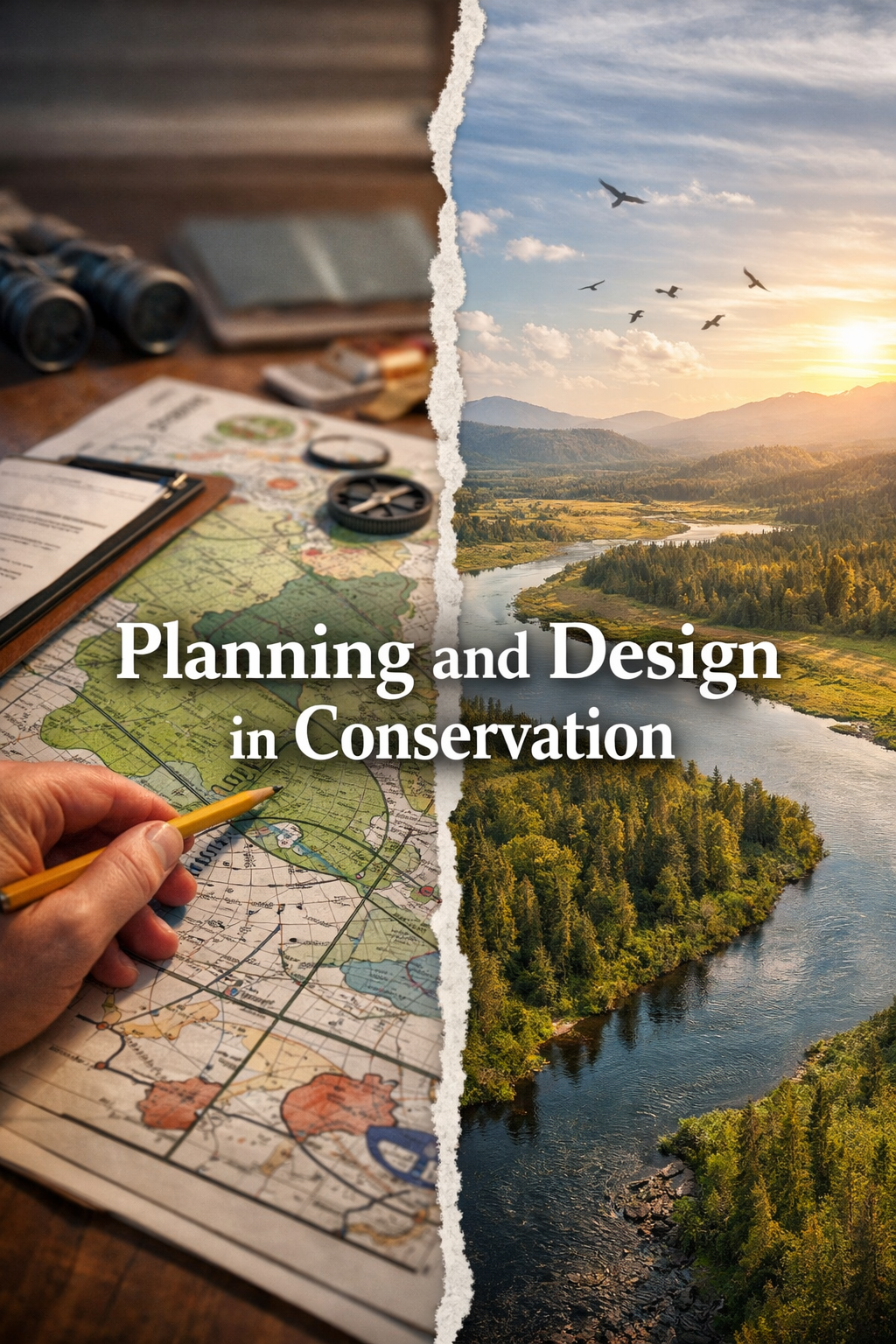
Conservation efforts are often described in terms of plans: strategic plans, conservation plans, management plans, and recovery plans. Planning plays a central role in organizing action, coordinating priorities, and translating goals into implementable steps. But planning is only one part of how conservation decisions come into being. Before plans are written, choices are already shaped by how problems are framed, who participates, and what constraints are treated as fixed.
2. Why Conservation Decision Systems Are Under Strain
The reason this upstream context deserves attention is that the conditions under which conservation operates have changed. Climate change, biodiversity loss, and growing human pressures are reshaping landscapes faster and in more interconnected ways than many conservation systems were designed to accommodate. Assumptions of relative stability—once sufficient for site-based planning and incremental improvement—are increasingly strained. Under these conditions, conservation outcomes depend not only on better plans, but on how the decision systems that shape those plans are structured in the first place.
3. What Conservation Planning Is Designed to Do
As a discipline, planning focuses on working within defined goals, mandates, and constraints to compare alternatives, sequence actions over time, and allocate resources. It is particularly effective at translating agreed-upon objectives into coordinated actions, especially at site-specific or project scales where responsibilities and conditions are relatively clear. In this way, planning supports conservation action by operating within decision systems whose basic structure has already been set.
4. Design and Decision-Making in Conservation
Design addresses challenges that are fundamentally human in nature. As a discipline, it focuses on shaping the conditions under which people make decisions together: whose perspectives are included, how problems are framed, how constraints are defined or renegotiated, and what tradeoffs are agreed to. Rather than translating established objectives into action, design focuses on structuring the decision context itself so that subsequent planning can proceed on a coherent and durable foundation. In fields that deal with complex, people-centered systems, design provides a way to organize decision-making before more specific strategies, plans, or actions are specified.
5. Why Large Landscape Scale Matters for Conservation
These issues become especially consequential at large landscape scales. Ecological processes such as species movement, hydrological flows, disturbance regimes, and climate-driven shifts routinely extend beyond individual sites or management units. Yet conservation decisions affecting those processes are often made independently, within bounded jurisdictions or project footprints. Under conditions of pollution, accelerating climate change, biodiversity loss, and cumulative human pressures, this structural mismatch becomes increasingly consequential. Traditional conservation planning—effective for optimizing actions within defined sites or mandates—struggles to accommodate ecological dynamics that span multiple jurisdictions, time horizons, and interacting pressures. When ecological dynamics operate across entire landscapes but decisions are made piecemeal, planning alone is rarely sufficient to produce outcomes that remain coherent, resilient, or durable over time.
6. Landscape Conservation Design as an Upstream Approach
Landscape conservation design (LCD) applies this people-centered design approach specifically to conservation challenges that unfold across entire landscapes. Rather than beginning with predefined sites, targets, or actions, LCD focuses on shaping the decision context within which people collectively explore and make conservation choices. It emphasizes how participants are convened, how different forms of knowledge are brought into the same decision space, how spatial information is used to surface options and tradeoffs, and how strategies are developed in ways that remain credible as conditions change. In this sense, LCD does not replace conservation planning; it operates upstream of it, establishing the decision foundation on which planning can then build.
7. Up Next: The Landscape Conservation Design Process
Taken together, this distinction between design and planning clarifies why new conservation approaches are being discussed at all. Planning remains essential for translating decisions into action, but it depends on decision contexts that are coherent, legitimate, and aligned with the scale and complexity of the challenges at hand. Landscape conservation design focuses on shaping those contexts first, especially where conservation outcomes depend on how people make decisions together across entire landscapes. In future posts, we’ll look more closely at the design process itself—how inclusive convening, interdisciplinary assessment of current and plausible future conditions, interactive spatial design, and informative strategy design work together to facilitate collaborative decisions that promote social-ecological systems (e.g., landscapes) that are resilient and sustainable for current and future generations.