🌎Earth Day Edition: Designing What Comes Next - Ecoregional Cooperatives and the Architecture of Landscape Governance
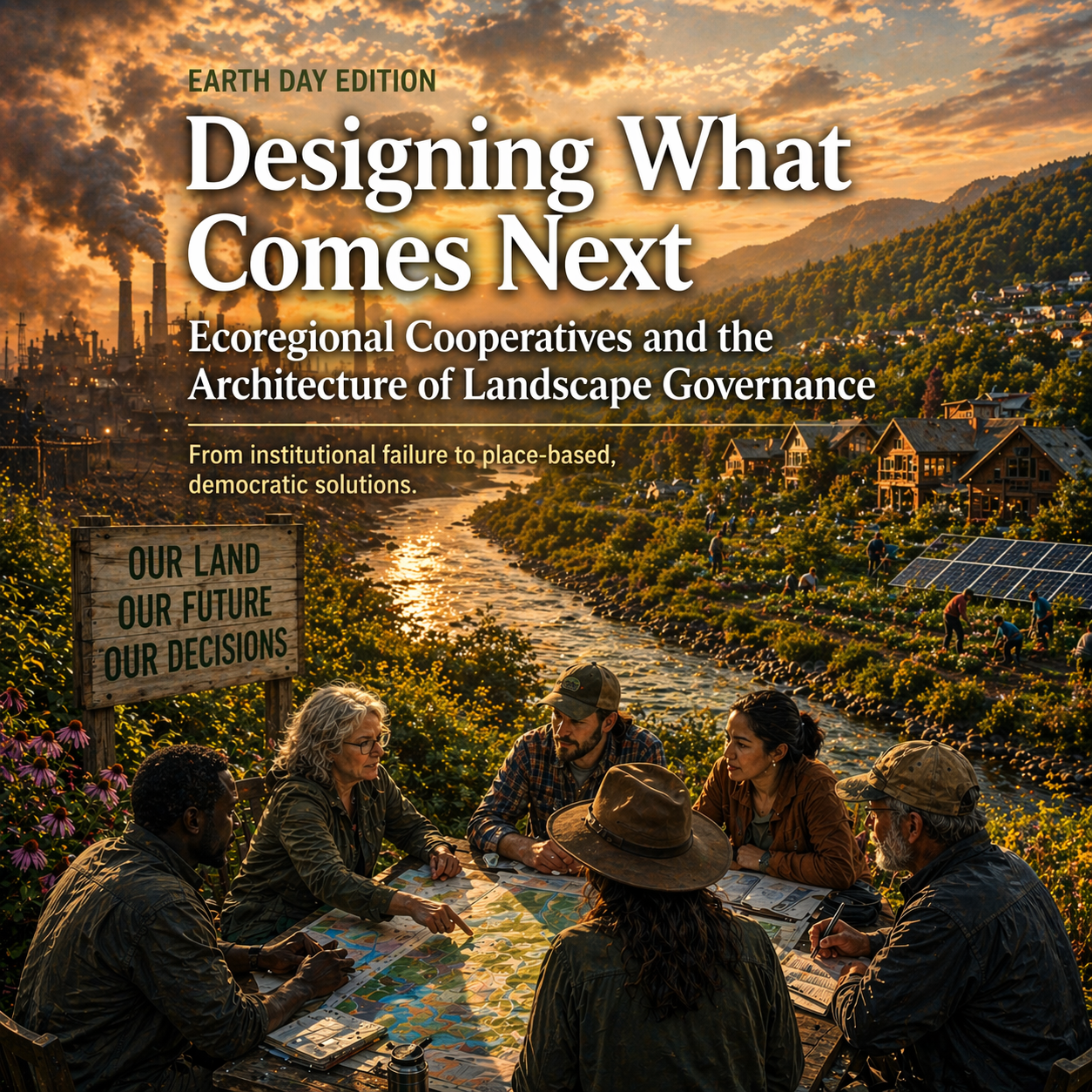
Earth Day began as a public response to environmental crisis. This year, it also invites reflection on how we can help build what comes next when existing institutions fall short.
The breakdown of federal environmental governance raises a practical question: how will coordination be organized under accelerating climate change, ecological disruption, and fragmented authority? Climate and ecological change continue regardless of institutional failure, and the need for decisions that respond to those conditions does not disappear when federal leadership weakens. If governance is no longer being reliably carried out from the top down, the question becomes: what kind of institutional architecture can organize it from the ground up? Governance does not reappear on its own. It has to be designed.
Self-directed conservation partnerships have begun to point toward part of an answer, but they also expose a deeper institutional problem. Practitioners know that many ecological processes cross jurisdictions, while decisions affecting those processes are often made separately by different authorities, with different timelines and priorities. One decision may support progress in one part of a landscape while another undermines it somewhere else, or simply fails to connect. Over time, coordination becomes difficult to sustain, and local gains can be hard to carry beyond the places where they originated. If governance is to work at the scale these conditions demand, there has to be a way to connect decisions that are now made separately.
A Social-Ecological Approach to Conservation
Ecological processes do not follow political boundaries, and many of the conditions conservation seeks to address unfold across large geographic regions (i.e., landscapes), while decision-making is often organized in siloed jurisdictions and authorities. If decisions are to match the scale of ecological conditions, governance has to be organized in ways that align decisions with those processes and connect decisions affecting the same landscape that are currently made separately.
Ecoregional Cooperatives (ECOs)
One idea I have been ruminating on in my book, Designing Nature’s Half, is that of Ecoregional Cooperatives, or ECOs. The idea grows out of two related conditions: the scope and scale of the ecological challenges we face demand a new approach to conservation, and those challenges are unfolding under fragmented authority and weakening federal and, in some cases, state leadership. At their core, ECOs point toward a way of organizing people and knowledge within shared ecological regions so decisions affecting a landscape can be developed as an integrated whole rather than as disconnected parts.
Landscape Conservation Design
Producing decisions at the landscape scale requires a way for stakeholders to develop and compare alternatives together so choices can be formed across a shared ecological region. That is where landscape conservation design (LCD) comes in. In my book, LCD is the process through which inclusive participation, deliberation, and examining alternatives come together to help form integrated decisions at the scale a shared landscape requires.
Who
Who participates in the decision system matters because decisions at the landscape scale require a multi-jurisdictional and multi-sector approach that brings together the authorities, responsibilities, and knowledge needed to address a shared ecological region. But participation is not only about institutions. People living on the land need to be part of conservation and development decision-making and share in the benefits of those decisions. Who is involved shapes what options are considered and which decisions can hold.
Why
Shared purpose helps define how ecological integrity, livelihoods, conservation of ecosystem services, and long-term public benefit are considered together as part of a balanced approach to landscapes. In that sense, the premise behind Designing Nature’s Half is not only about conserving nature, but about relating the needs of nature and people through decisions that can hold over time. Shared purpose gives direction for examining alternatives and forming decisions.
How
Social-ecological alternatives are examined through a process that allows stakeholders to compare options, understand consequences, and deliberate over choices before decisions are made. But how decisions are made is not only about examining alternatives. It is also about the deliberative, democratic, and participatory processes through which those choices are formed. How decisions are made shapes both their legitimacy and their capacity to hold over time.
What
Decisions provide direction for action and yield benefits that can be recognized across a landscape, including both direct and indirect benefits, as well as tangible and intangible ones. Those benefits include ecological sustainability, community well-being and social cohesion, regenerative economic opportunity, and greater public capacity to steward shared landscapes over time. The decisions made help determine whether governance proves legitimate, practical, and worth sustaining. Those decisions must benefit nature and people.
Ecosocialism as a Guiding Principle
Designing institutions capable of organizing multi-stakeholder decisions at the landscape scale raises questions about how ecological sustainability, community well-being and social cohesion, and regenerative economic opportunity are organized together within shared landscapes. One tradition attracting growing interest in these discussions is ecosocialism. In this context, ecosocialism refers to the proposition that democratic participation and cooperative stewardship can help organize those social-ecological and economic relationships in ways that serve shared public benefit.
Seen in that light, Ecoregional Cooperatives can be understood as one possible democratic, place-based expression of those principles. Organizing decision-making and stewardship at the scale of shared landscapes does not require distant centralized control. It can emerge through cooperative institutions that connect ecological conditions and shared public benefit through democratic participation. In that sense, Earth Day raises the question of the immense environmental conditions we face and how people can organize themselves to address them through cooperation.
Attend the 2026 Ecosocialism Conference, London, London South Bank University, May 30, 2026. Remote attendance available.