🌎Conservation Can’t Wait For The Next Election
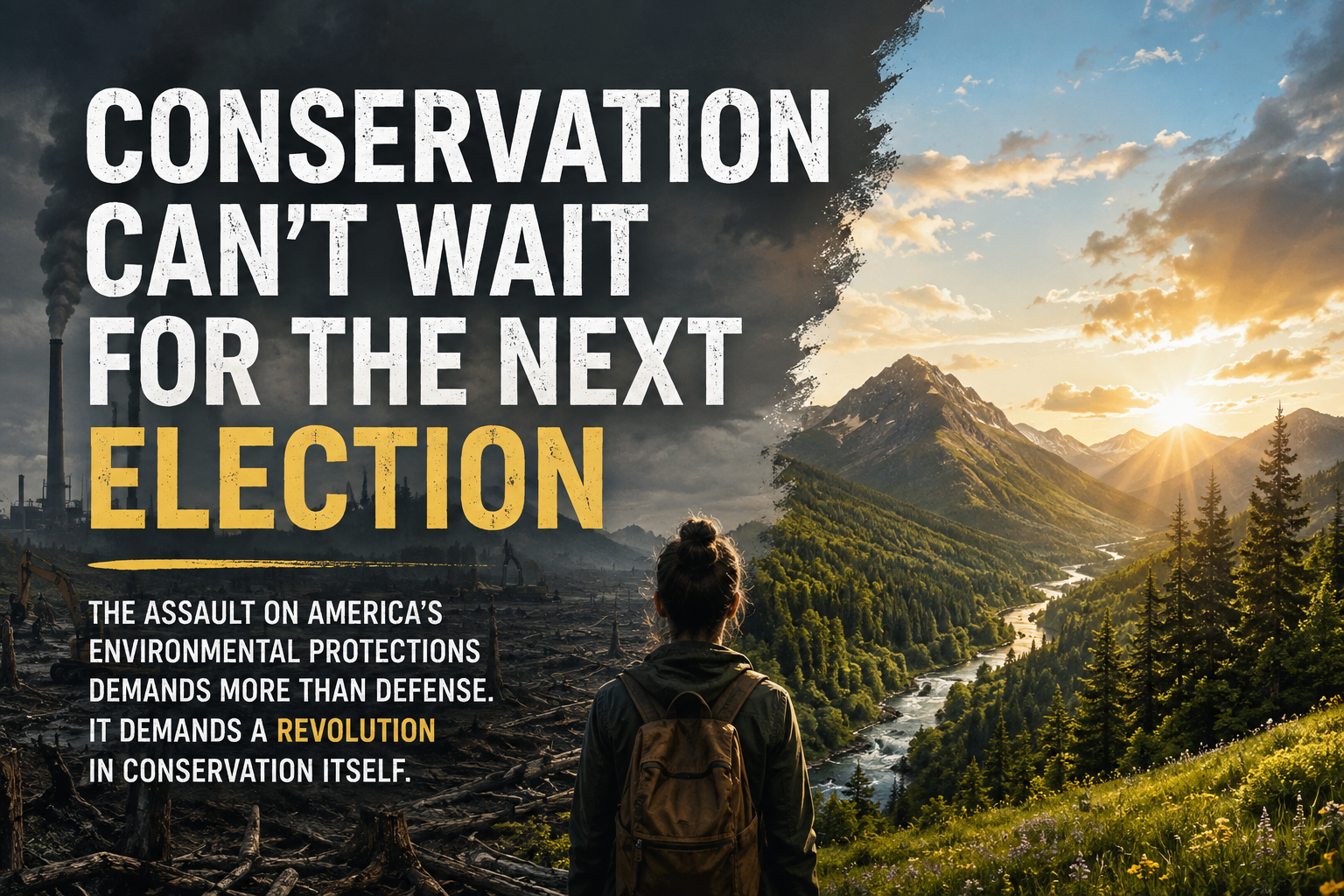
The Assault on America’s Environmental Protections Demands More Than Defense. It Demands A Revolution In Conservation Itself.
This week, the Trump regime moved another step toward eliminating one of America's most consequential forest protections.
The U.S. Forest Service formally proposed rescinding the 2001 Roadless Area Conservation Rule, potentially removing federal road-building and logging restrictions from 60 millions of acres of largely undeveloped national forests.
The Roadless Rule has survived for twenty-five years.
It may not survive this regime.
And that should force the conservation movement to confront a much larger question:
What happens when our strategy for protecting nature depends on political institutions that can systematically dismantle those protections?
This is bigger than the Roadless Rule
Since returning to office, Trump has moved across virtually every major front of federal environmental policy.
Consider what has already happened or is underway:
Roadless national forests (August 2026): The Forest Service has proposed rescinding the Roadless Rule, threatening federal protections across 60 million acres of federal land. Associated Press report
National monuments (July 2026): Bears Ears and Grand Staircase–Escalante have been reduced by roughly 90 percent, removing monument status from millions of acres. Associated Press report
Endangered species (July 2026): Habitat-related protections under the Endangered Species Act have been weakened. Reuters report
Public lands (May 2026): The BLM Public Lands Rule has been rescinded, reversing a policy that elevated conservation and restoration within multiple-use management.
Climate (February 2026): EPA rescinded the 2009 Endangerment Finding, a foundation of federal greenhouse-gas regulation under the Clean Air Act. Reuters report
Pollution: Air, water, vehicle-emission, power-plant, and industrial protections have been targeted for rollback. Associated Press investigation
Fossil fuels: Oil, gas, and coal development has been expanded across federal lands, including Alaska.
Logging: Federal agencies have been directed to accelerate timber production from public lands. Reuters report
Environmental review (2025): Government-wide regulations implementing the National Environmental Policy Act have been rescinded, substantially restructuring federal environmental review. Associated Press report
Taken individually, these are environmental battles.
Taken together, they reveal a systematic effort to rewrite the relationship between government, industry, and the natural world. Simply put: there’s a war on conservation.
Every one of the above deserves resistance.
Sue. Organize. Comment. Fight in Congress. Fight at the ballot box.
But defense cannot be the conservation movement's theory of change.
The forces transforming the world are moving on a different clock
There is an understandable strategy for surviving this moment:
Hold the line. Win the midterms. Win the presidency. Restore what was lost.
We should do all of those things.
But that strategy assumes the larger social-ecological system will remain sufficiently stable while we wait.
It won't.
Hyper-capitalism continues concentrating extraordinary wealth and power to the 1%, while shifting ecological and social costs onto everyone else. Oligarchs increasingly influence governments, markets, media, and technology. Right-wing authoritarian movements are gaining political power around the world.
Meanwhile, greenhouse-gas pollution continues to accumulate. Climate change is accelerating. Biodiversity continues to decline under the combined pressures of climate change and the conversion of natural systems to human-made systems.
These forces interact across the same landscapes conservation is trying to protect.
And none of them is waiting for the next election.
So we need to ask:
Does conservation have a theory of change commensurate with the forces changing the world?
For generations, conservation built public support, passed laws, created agencies, established protected areas, secured funding, and defended those achievements through advocacy and the courts.
That strategy accomplished extraordinary things.
But defense is reactive. It allows someone else to decide which forest gets logged, which monument gets reduced, which protection disappears—and then asks conservation to mobilize quickly enough to stop it.
Meanwhile, the forces transforming social-ecological systems are accumulating political and economic power. They are changing laws, rewriting regulations, opening landscapes to extraction, and creating the conditions under which tomorrow's decisions will be made.
If conservation responds primarily by defending yesterday's achievements, we will spend more and more of our energy trying to recover what was lost while the conditions determining tomorrow's landscapes are created around us.
That is not a strategy equal to this moment.
Conservation needs a revolution
I use that word deliberately.
Conservation needs a revolution.
This isn't about abandoning government or the institutions generations of conservationists fought to create. Federal environmental laws matter. Public agencies matter. Courts matter. Elections matter.
But conservation must become capable of doing something more.
The United States already possesses extraordinary conservation capacity: scientists, Tribal nations, public agencies, landowners, organizations, universities, businesses, communities, landscape partnerships, and millions of people who care deeply about the places where they live.
Much of that capacity remains fragmented across institutions, jurisdictions, ownerships, programs, and funding streams.
The revolutionary act is to organize it.
Build conservation systems capable of operating across entire landscapes. Make difficult decisions collectively. Sustain commitments through political disruption. Create institutions capable of enduring when administrations and funding priorities change.
Most importantly, stop allowing conservation to be defined primarily by what we are trying to prevent.
Start designing the future we want to create.
That is transformational conservation.
And we do not need permission from the next Congress or president to begin.
So what are we going to build?
That question sits at the heart of Designing Nature's Half: An Architecture for Conserving 50% by 2050.
The book asks what conservation must become if we take seriously the world in which it now operates.
Because we aren't going back.
Tomorrow's landscapes will either continue emerging from disconnected decisions increasingly shaped by short-term political and economic power, or we will develop the capacity to design their futures together.
That is the revolution Designing Nature's Half proposes.
Conservation becomes more than protecting what remains.
It becomes an active force in shaping the future.
But build while we fight.
Fight the Roadless Rule repeal.
Fight for endangered species, climate protections, clean air and water, public lands, intact forests, wildlife, and the institutions generations before us created.
Take them to court. Take them to Congress. Take them to the ballot box.
Take to the streets!
But build while we fight.
Anything conservation builds that depends entirely upon favorable political power remains vulnerable when that power changes hands.
We have to stop relearning that lesson.
Designing Nature's Half launched a pre-campaign page on Kickstarter this week.
I thought I would spend the weeks ahead explaining why another conservation book matters.
Look around.
We need more than another conservation book.
We need a conservation movement capable of doing more than managing decline until political conditions improve.
So I'm asking for more than help publishing a book.
I'm asking whether there are enough of us ready to begin building the conservation movement this century demands.
The Trump regime isn't waiting.
The oligarchs aren't waiting.
Climate change isn't waiting.
Extinction isn't waiting.
Why the hell are we?
Vote like the future depends on it.
But don't wait for an election to save the landscapes you love.
That's our job.
And it starts now.