🌎Nature Works Across Landscapes. Conservation Should Too.
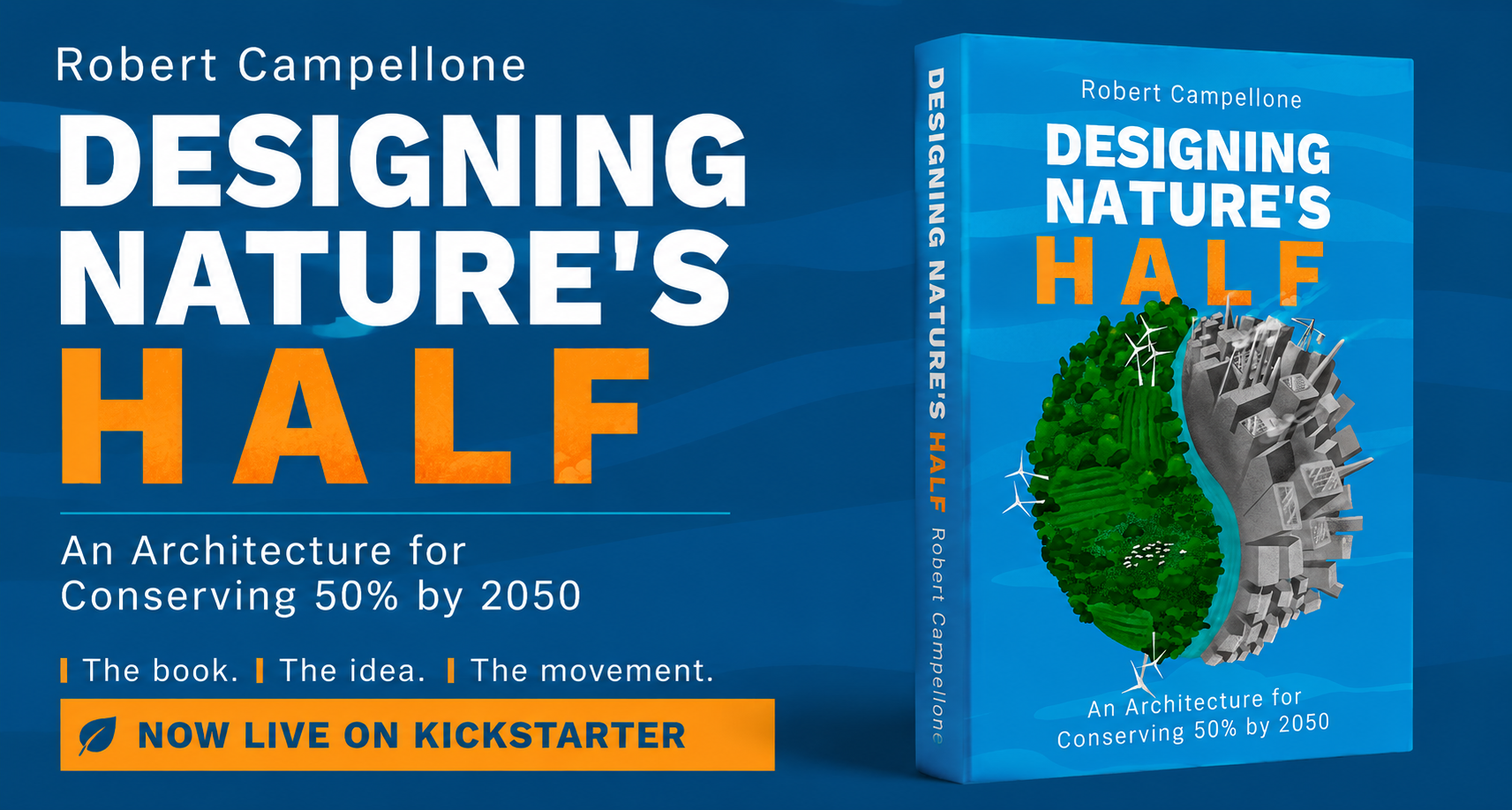
Designing Nature’s Half is now live on Kickstarter—and the campaign is about more than publishing a book.
Pollution, climate change, and biodiversity loss are often treated as separate environmental problems. Increasingly, they are understood as an interconnected Triple Planetary Crisis.
Their effects do not respect the boundaries we use to organize conservation.
Pollution moves through air, water, soil, and food webs. Greenhouse gas emissions intensify climate change, altering temperatures, water availability, disturbance regimes, and habitats. Together, these pressures accelerate biodiversity loss. As species and ecological functions are lost, ecosystems can become less capable of absorbing carbon, filtering pollutants, regulating water, and adapting to further change.
These are interconnected problems operating across landscapes.
Our responses often are not.
Conservation remains divided among jurisdictions, institutions, and economic sectors. Each may be doing important work. But ecological systems do not reorganize themselves around our administrative boundaries.
That mismatch is the problem at the heart of my forthcoming book, Designing Nature’s Half: An Architecture for Conserving 50% by 2050.
The book begins with an ambitious proposition: conserving roughly half the Earth by 2050 represents a defensible benchmark for sustaining biodiversity over the long term.
But setting a target is the easy part.
The harder question is: How do we organize ourselves to achieve it?
Designing Nature’s Half argues that conservation must become capable of working across whole landscapes and across the jurisdictions, institutions, and sectors whose decisions shape them. That means bringing together the people who hold authority, responsibility, and knowledge; developing a shared understanding of changing landscape conditions; considering conservation priorities alongside other land and water uses; and building institutions capable of sustaining decisions over time.
No single landscape stakeholder can do that.
It requires a community.
From Manuscript to Book
I've spent the past several years developing Designing Nature’s Half. The manuscript has undergone technical review by conservation practitioners and professional editorial review. The figures and tables are complete. Landscape photography has been incorporated, and work on the final cover is underway.
I'm now completing my final review before the manuscript moves through proofreading, layout, and production.
And this week, another major step began.
The Kickstarter campaign for Designing Nature’s Half is now live.
The 30-day campaign will help cover the remaining costs of producing, printing, and distributing the book.
But I hope it does something else as well.
I hope it begins building a community around the proposition that conservation can—and must—be organized differently.
Some people in that community may read the book. Others may bring it into conservation organizations, agencies, classrooms, or communities. Some will challenge its arguments. Others may take pieces of its architecture and adapt them to landscapes I will never see.
That's how ideas begin to matter beyond the pages where they were written.
After years of research, writing, conversations, review, and revision, Designing Nature’s Half is becoming a book.
Now comes the next step: putting it into the hands of people who can do something with it.
The Kickstarter campaign is live now. If these ideas resonate with you, I invite you to support Designing Nature’s Half.
#ClimateChange #Conservation #CollaborativeConservation #ConservationPlanning #ConservationPolicy #Biodiversity #Kickstarter #LandscapeConservation #Pollution #Sustainability