🌎The In-Between Time
What Bears Ears reveals about transformational conservation
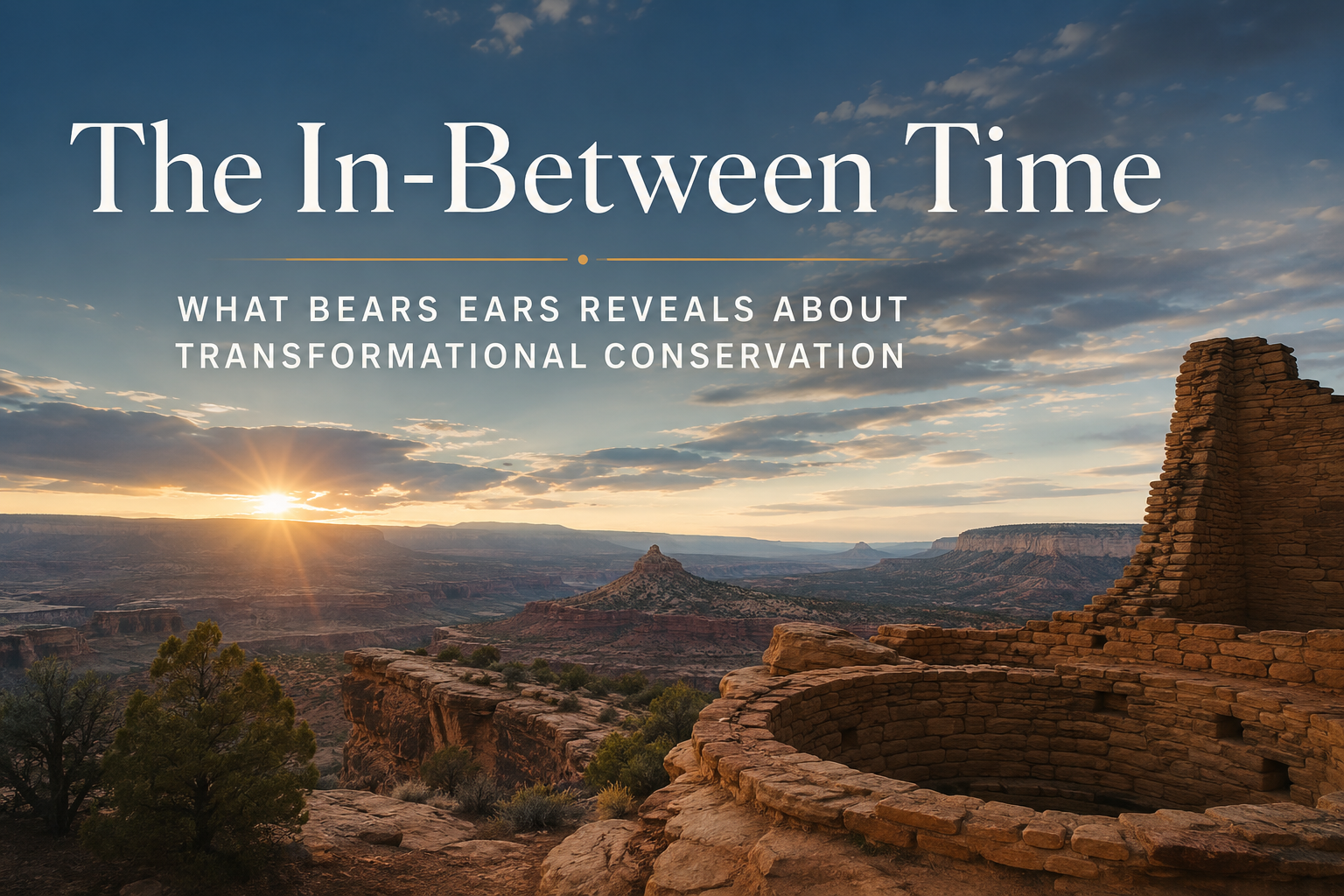
On July 13, Trump issued a proclamation that reduced Bears Ears National Monument by more than 90 percent. But Bears Ears is far more than a federal monument. Long before it became public land, it was, and remains, the ancestral homeland of the Hopi Tribe, Navajo Nation, Ute Mountain Ute Tribe, Pueblo of Zuni, and Ute Indian Tribe of the Uintah and Ouray Reservation. It is a living social-ecological landscape where culture, biodiversity, sacred places, archaeological sites, and Traditional Indigenous Knowledge have been intertwined for 13,000 years.
Most of the public discussion has focused on the monument's dramatically reduced boundaries.
It should.
But another loss deserves equal attention.
Bears Ears and the Institutional Question
For nearly a decade, five Tribal Nations worked alongside federal land managers to develop a new model of conservation governance. The Bears Ears Commission did something unprecedented. It brought Traditional Indigenous Knowledge into the heart of landscape planning and stewardship, helping produce the first Tribal-led national monument Resource Management Plan ever adopted by the federal government.
That work was never simply about managing public land.
It was about building the democratic capacity to steward a shared landscape.
With the stroke of a pen, the commission itself was abolished.
Years of trust, collaboration, and institution-building disappeared almost overnight.
That should trouble all of us, not only because of what happened at Bears Ears, but because it exposes a deeper challenge confronting conservation.
How do we build conservation systems capable of enduring across generations when political priorities can change every election cycle?
I've been wrestling with that question while writing Designing Nature's Half: An Architecture for Conserving 50% by 2050.
I call this historical moment “The In-Between Time.”
The In-Between Time
The Kunming-Montreal Global Biodiversity Framework sets out a bold vision: a world living in harmony with nature where, by 2050, biodiversity is valued, conserved, restored, and wisely used, maintaining ecosystem services, sustaining a healthy planet, and delivering benefits essential for all people.
Its 2030 targets begin charting a path toward that vision.
Target 1 calls for participatory, integrated, biodiversity-inclusive spatial planning and management that respects the rights of Indigenous peoples and local communities.
Target 3 calls for conserving at least thirty percent of the planet's lands and waters through ecologically representative, well-connected, and equitably governed systems that recognize Indigenous and traditional territories and are integrated into wider landscapes.
Those commitments are ambitious.
They are also revealing.
They describe what the world hopes to achieve.
They say much less about how societies organize themselves to achieve it.
What collaborative decision systems and democratic institutions must we build now—in The In-Between Time—to make that vision achievable by 2050?
That question sits at the heart of Designing Nature's Half, my forthcoming book on landscape conservation design (LCD)—an architecture for moving from project-by-project planning to intentional landscape design.
Landscape conservation design begins with a simple observation.
We don't design landscapes. We plan individual projects.
Instead of allowing thousands of independent decisions to gradually determine the future of a landscape, landscape conservation design enables stakeholders to collaboratively design a shared future before individual projects are proposed.
That is transformational.
But Bears Ears reminds us that designing better landscape decisions is only half the challenge.
Those decisions must also endure.
If years spent building collaborative governance, integrating Traditional Indigenous Knowledge, and developing shared stewardship can disappear with a single presidential proclamation, then transformational conservation requires more than better planning.
It requires transforming the way conservation itself is organized.
Organizing Conservation Differently
For more than a century, Americans have looked to governments to lead conservation. That history has produced extraordinary achievements. But the challenges of the twenty-first century, including rolling back democratic institutions, demand something fundamentally different from the status quo. Transformational conservation requires landscape stakeholders to become co-creators, not simply beneficiaries, of conservation itself. It requires people to organize, make decisions, build institutions, and assume shared responsibility for the landscapes they hope to steward together.
Transformational conservation begins when landscape stakeholders stop asking who will save their landscapes and begin organizing themselves to steward them together.
In Designing Nature's Half, I call one institutional expression of that idea Ecoregional Cooperatives (ECOs).
Landscape conservation design provides the collaborative decision architecture through which stakeholders intentionally design the future of a landscape.
Ecoregional Cooperatives provide the democratic institutional architecture through which those shared decisions can be stewarded, adapted, and carried forward across generations.
Together, they represent one vision of transformational conservation—not simply protecting landscapes differently, but organizing conservation differently.
The lesson of Bears Ears reaches far beyond one monument.
It challenges us to think differently about conservation itself.
The vision of living in harmony with nature by 2050 will not be realized through aspirations alone.
It will depend upon what we choose to build today.
The future envisioned by the Kunming-Montreal Global Biodiversity Framework will be shaped not only by the landscapes we choose to conserve, but also by the collaborative decision systems and democratic institutions we choose to build now—in The In-Between Time.