Lasting Landscapes Require Lasting Institutions
What the International Day of Cooperatives reveals about transformational conservation
Each year, the United Nations' International Day of Cooperatives celebrates the contributions cooperative organizations make to communities around the world. This year's theme, "Cooperatives for a peaceful world", may seem unexpected. Cooperatives are more commonly associated with agriculture, housing, finance, or grocery stores than with peacebuilding.
Yet the theme points to a much deeper question.
How do societies intentionally achieve their most ambitious long-term goals?
The answer is rarely through good intentions alone.
Peaceful societies do not emerge by accident. They depend upon democratic institutions intentionally designed to cultivate cooperation, participation, trust, and shared responsibility over time.
Every enduring societal goal depends upon institutions designed to help society achieve it.
That idea is more than aspiration. In Cooperatives and Peace: Strengthening Democracy, Participation and Trust (2019), Cooperatives Europe examines case studies from around the world showing how cooperative institutions have helped communities rebuild trust, strengthen democratic participation, and pursue common goals following conflict and division. The report's broader lesson extends beyond peacebuilding. Democratic institutions are not simply organizations. Properly designed, they cultivate the forms of collective action needed to achieve society's most enduring aspirations.
Reading the report made me wonder whether the conservation sector has been asking a different version of the same institutional question.
If peaceful societies depend upon democratic institutions intentionally designed to cultivate cooperation, what democratic institutions should we intentionally design to cultivate the shared decisions needed to create sustainable social-ecological landscapes?
I've been wrestling with that question while writing Designing Nature's Half, my forthcoming book on landscape conservation design (LCD) — an architecture for moving from project-by-project planning to intentional landscape design.
In last week’s blog, I argued that we don't design landscapes; we plan individual projects. LCD begins by asking how stakeholders might collaboratively develop a shared vision for an entire landscape before individual projects gradually determine its future one permit at a time.
That is an important step toward transformational conservation.
It is not the final step.
Designing Democratic Institutions
Conservation has devoted enormous creativity to designing protected areas, restoration projects, conservation plans, collaborative partnerships, and increasingly sophisticated decision-making processes.
We have devoted far less attention to designing the democratic institutions through which those efforts can endure.
Yet landscapes evolve over decades. Organizations change. Administrations change. Funding priorities shift. Political leadership changes. Shared decisions that take years to develop can disappear far more quickly than the ecological systems they were intended to steward.
Conservation has learned that landscapes deserve intentional design.
Perhaps the democratic institutions through which conservation operates deserve the same level of intentional design.
Designing landscapes intentionally therefore raises a second design question.
What kinds of democratic institutions are capable of carrying shared landscape decisions forward through time?
The recently releasedTransformative Change Assessment (IPBES, 2024) argues that addressing biodiversity loss requires changing not only our practices, but also the structures through which societies organize themselves. That observation suggests that transformational conservation is not simply a scientific or planning challenge.
It is also an institutional design challenge.
Institutional design deserves as much attention as landscape design.
Designing Institutions for Shared Landscapes
That conclusion led me to an unexpected place.
The cooperative model is rarely discussed as an institutional framework for landscape conservation. Yet the democratic characteristics highlighted throughout the cooperative literature are strikingly similar to the governance requirements of transformational conservation.
Cooperatives are democratic institutions.
They cultivate participation.
They build trust.
They create shared responsibility.
They help people with different interests pursue common goals over long periods of time.
Those qualities explain why cooperative institutions have contributed to peacebuilding.
They also suggest why cooperative governance deserves serious consideration within landscape conservation.
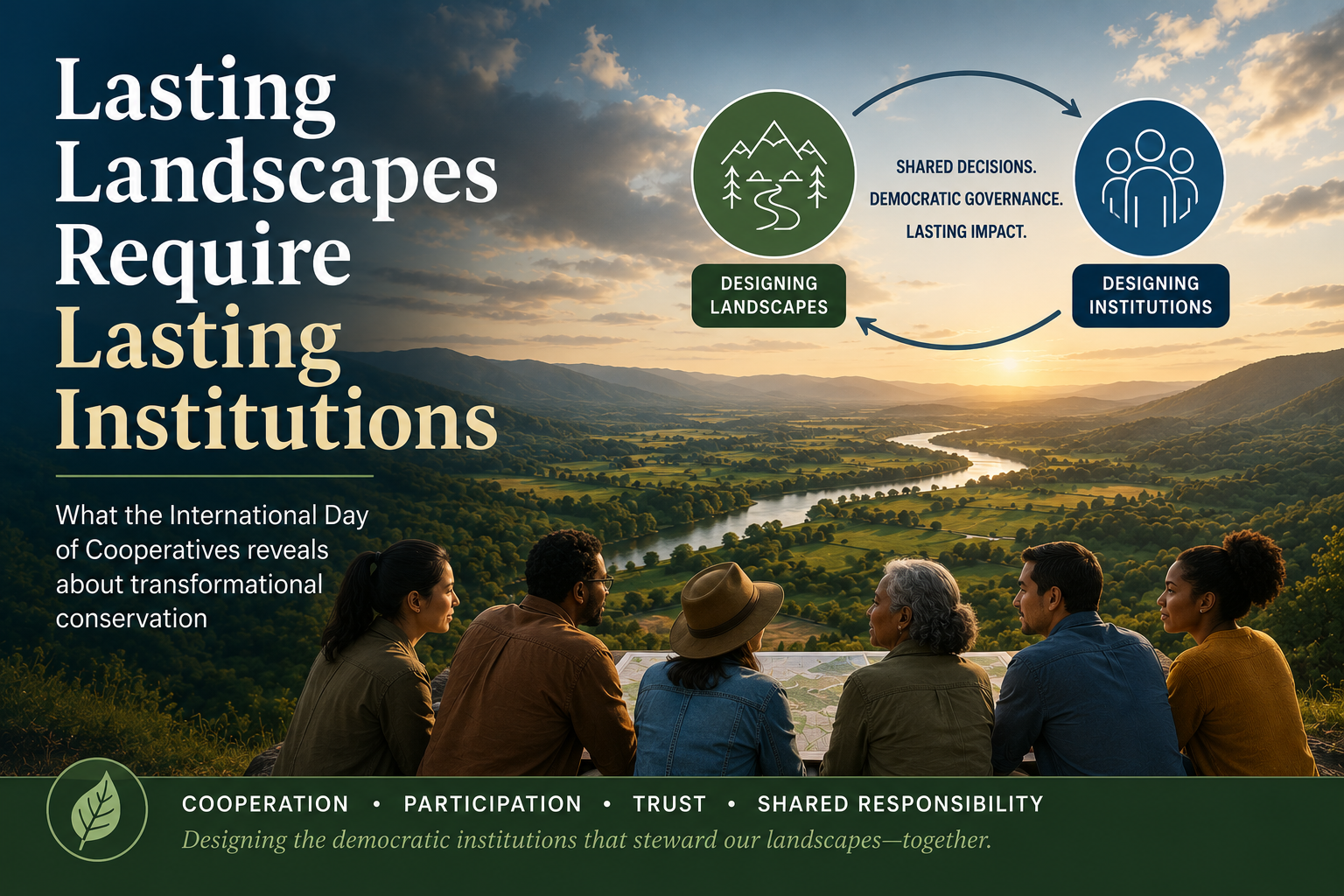
In Designing Nature's Half, I argue that ecoregional cooperatives (ECOs) provide the democratic institutional architecture within which landscape conservation design operates.
Landscape conservation design and ecoregional cooperatives address different aspects of the same challenge. Landscape conservation design provides the decision architecture by enabling stakeholders to collaboratively develop shared landscape decisions. Ecoregional cooperatives provide the democratic institutional architecture by convening stakeholders, facilitating the landscape conservation design process, governing collaborative decision-making, institutionalizing shared commitments, and sustaining those decisions through implementation, learning, and adaptation over time.
The goal is not to create cooperatives for their own sake.
The goal is sustainable social-ecological landscapes.
Landscape conservation design helps society intentionally develop shared landscape decisions.
Ecoregional cooperatives help society intentionally design the democratic institutions capable of carrying those decisions forward.
Lasting Landscapes Require Lasting Institutions
The International Day of Cooperatives reminds us that peaceful societies do not emerge by accident. They are cultivated through democratic institutions intentionally designed to help people cooperate, build trust, and pursue common goals together.
Transformational conservation deserves the same level of institutional imagination.
Not because peace and conservation are the same challenge.
But because both are long-term societal goals that depend upon institutions intentionally designed to cultivate the forms of collective action they require.
We have spent decades learning how to design landscapes more intentionally.
Perhaps the next step is learning how to design the democratic institutions that will steward them.
Lasting landscapes, like peaceful societies, do not emerge by accident.
They are cultivated through institutions intentionally designed to help people pursue long-term goals together.
Lasting landscapes require lasting institutions.