When Federal Climate Policy Unravels: Ecoregional Cooperation and Landscape Design
When Legal Foundations Shift
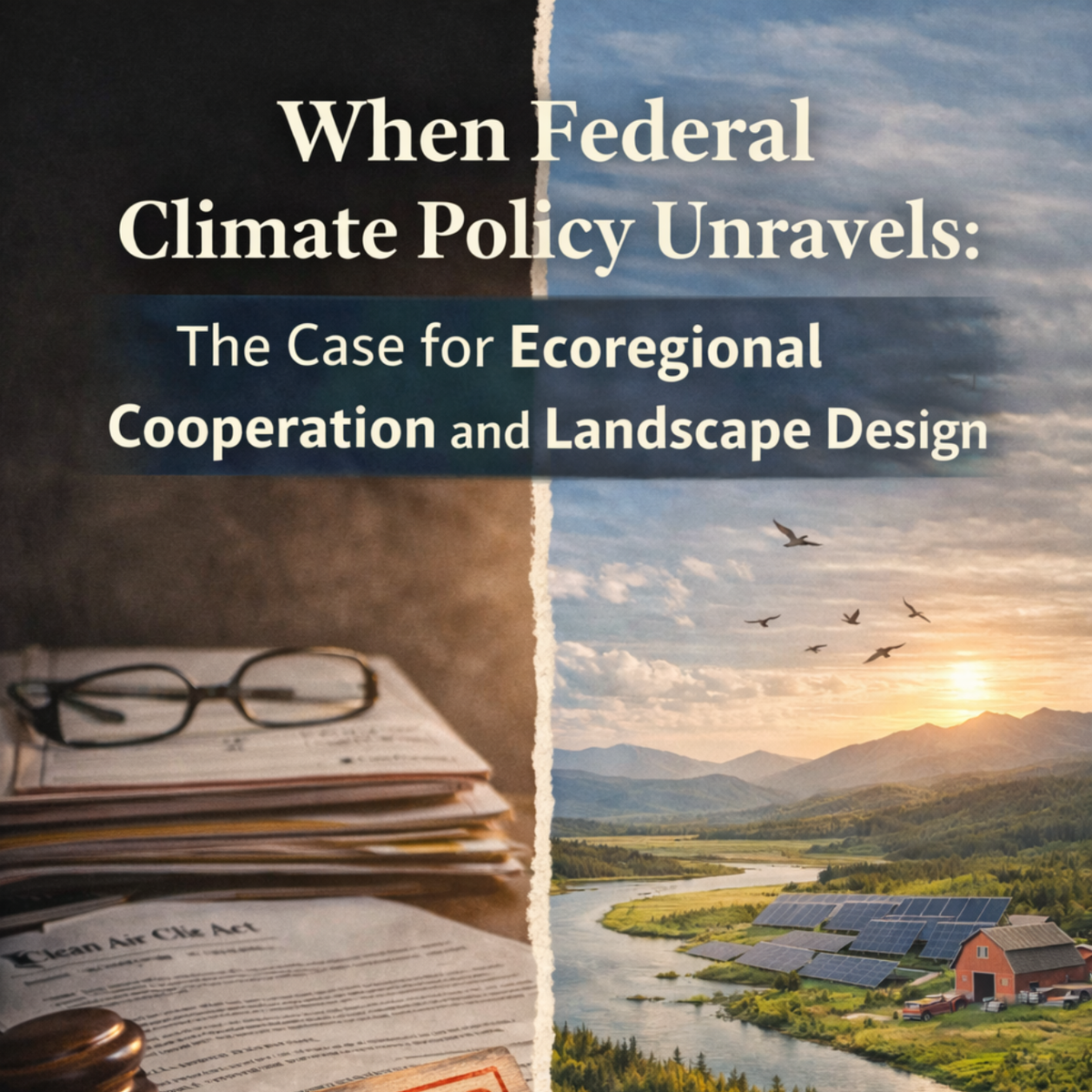
This week, the U.S. Environmental Protection Agency announced it will formally repeal the 2009 climate “endangerment finding”, the scientific determination under the Clean Air Act that greenhouse gases endanger public health and welfare and thus require regulation. That finding has been the legal foundation for federal climate protections for nearly two decades. The repeal reportedly represents the largest deregulatory action in U.S. history and will dismantle the basis for many emissions standards across vehicles, power plants, and other major sources of greenhouse pollution.
Who Defines The Problem?
That’s important news — not just because of what it means for U.S. climate policy, but because it spotlights a deeper challenge for conservation and sustainability: who gets to define a problem and on what basis decisions are made.
In many conservation frameworks, we assume that the scientific foundation for action is stable and uncontested: we agree that greenhouse gases harm the climate, species are threatened, and ecosystems provide critical services. Planning then takes those assumptions as given and translates them into priorities and actions.
When Planning Becomes Unstable
But when the boundary assumptions themselves — in this case, the scientific and legal recognition of climate risk — are revoked at the stroke of a pen, planning becomes a means of implementing maladaptive policies. Priorities can shift overnight, not because the world changed, but because the decision context was reshaped politically. That’s not just a bureaucratic glitch. It’s a structural vulnerability. And if not addressed in some productive way, it ultimately impacts everyone.
The Case for Ecoregional Cooperation
This is where the idea of Ecoregional Co-ops and landscape conservation design — a core focus of Designing Nature’s Half — becomes relevant on-the-ground.
If formal decision systems can be undone so easily at the national scale, then bottom-up and regionally grounded decision-making systems that integrate science, community values, jurisdictional needs, and shared responsibilities may be more than just a complement to top-down planning. They may be a necessary condition for durable sustainability outcomes.
Embedding Decision Authority in Landscapes
Ecoregional Co-ops — bridging entities that convene stakeholders across boundaries, assess conditions together, and design decisions with shared legitimacy — aren’t just a way to optimize a plan. They are a way to embed decision authority at the landscape-level, outside of any single political or regulatory regime that can shift with the stroke of a pen.
That isn’t to suggest that such Co-ops replace federal policy. It’s to acknowledge that, in practice, the resilience of a conservation strategy depends less on who writes the policy and more on how decisions are structured, shared, and sustained across people and places.
Conservation as a Governance Challenge
News like this — a central authority rescinding the foundation of national climate protections — reminds us that conservation isn’t just a science of ecosystems. It’s a governance problem, a problem of how we bind people together around shared risk, shared knowledge, and shared responsibility across ecological, political, and economic landscapes.
Where Does Durable Authority Live?
This moment challenges us to think about where decision authority truly lives, and how landscape-centered institutions — like Ecoregional Co-ops — might carry legitimacy even when national systems are in decline.
On the DNH website, I’m working through what that means for real decision systems across regions — how ecoregional-level co-production, shared assessment of conditions, and collective design practices can help build sustainable, socio-ecological landscapes in the long run.
If this resonates, you can explore the longer essays there that are being developed in service of the Designing Nature’s Half project.
This is one thread in a larger conversation.