🌎A World Environment Day Reflection: Designing Nature's Half and the Work Ahead
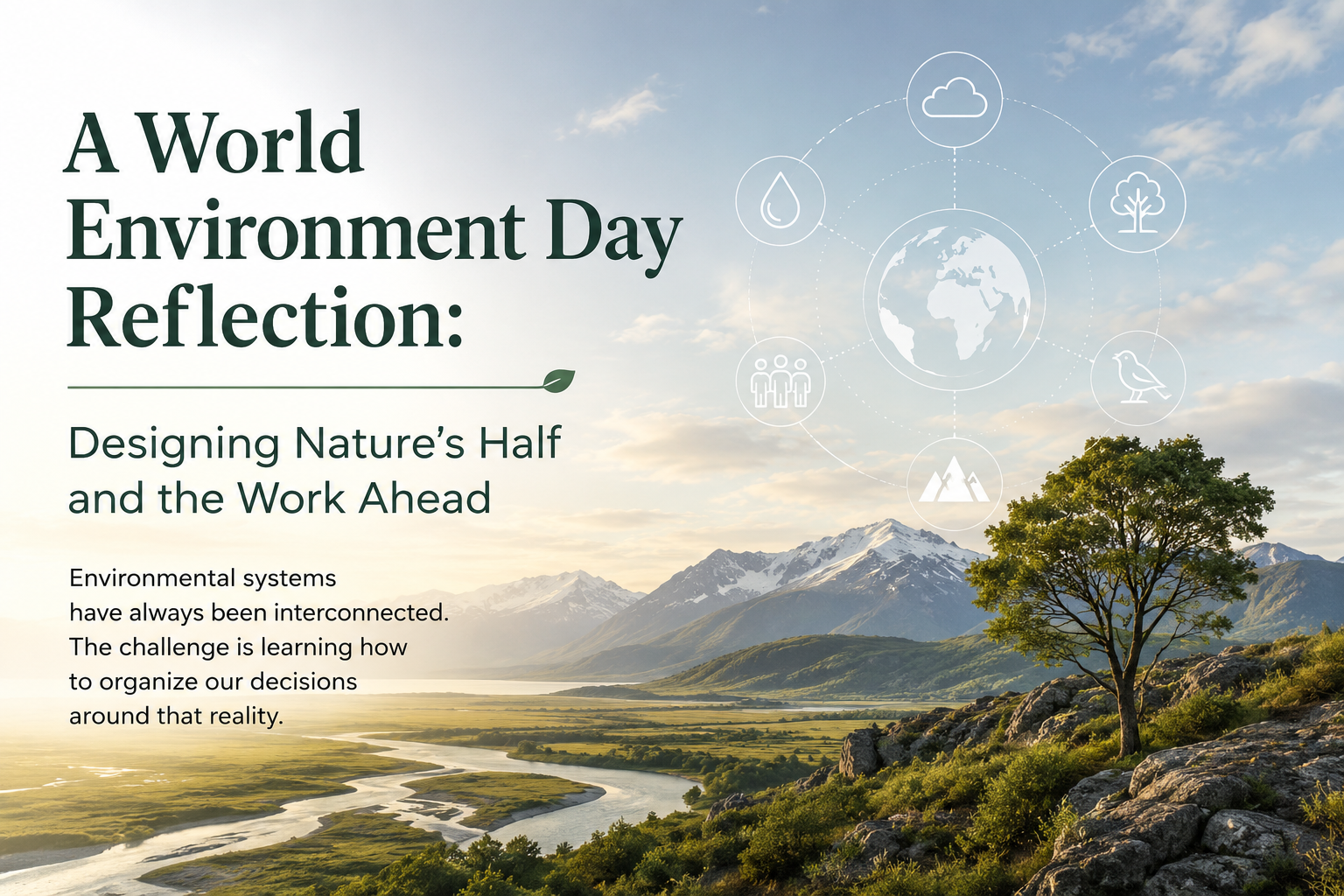
Environmental systems have always been interconnected. The challenge is learning how to organize our decisions around that reality.
Each year on June 5, World Environment Day encourages global reflection on the environmental challenges that shape our collective future. Established by the United Nations in 1972, it has become the world’s largest international environmental observance, focusing public attention on issues such as climate change, biodiversity loss, pollution, and other environmental challenges.
The primary purpose of World Environment Day has always been to raise awareness. Such awareness is essential, as environmental progress begins when individuals recognize problems and determine that action is necessary.
More than fifty years later, however, awareness alone is no longer sufficient to address environmental challenges.
Environmental issues are now increasingly understood as interconnected rather than isolated. Climate change influences water systems, while land use affects biodiversity. The condition of ecosystems determines resilience to drought, wildfire, flooding, and other disturbances. Decisions made in one location often have consequences elsewhere. Environmental systems interact across landscapes and over time in ways that rarely correspond with political boundaries or institutional responsibilities.
This year, Azerbaijan hosts World Environment Day under the theme: Inspired by Nature. For Climate. For Our Future.
The theme is compelling not only for its focus on climate, but also because it reflects a growing recognition that environmental challenges cannot be addressed in isolation. Climate, biodiversity, and human systems increasingly interact within connected social-ecological systems.
As understanding of these connections deepens, a more fundamental question emerges.
How should society organize decision-making across the systems that shape environmental outcomes?
From Awareness to Organization
For decades, environmental policy, conservation, planning, and resource management have achieved significant successes. Species have been recovered, lands protected, scientific understanding expanded, and collaborative partnerships established across regions and sectors.
However, many decisions affecting environmental systems remain fragmented across institutions, jurisdictions, sectors, and timeframes.
Environmental systems have always been interconnected. What has changed is our understanding of those connections. Many decision-making structures, however, remain fragmented.
This observation does not diminish the value of existing environmental efforts. Protected areas, restoration initiatives, climate adaptation programs, scientific research, and collaborative partnerships remain essential. The primary challenge now concerns organization: how decisions are related across landscapes, how priorities are coordinated across institutions, and how stewardship is sustained over time.
A Milestone Along the Way
In many respects, this question has guided much of my professional work.
It is also the question that ultimately formed the foundation of my soon to be released book: Designing Nature’s Half.
The manuscript examines how conservation decisions can be organized when ecological systems function across extensive landscapes and extended timeframes. Drawing on landscape conservation design, governance, and institutional development, it contends that many contemporary conservation challenges are fundamentally structural and proposes approaches for organizing decisions at the ecological scale over time.
Today, I am pleased to announce that the completed manuscript has been formally submitted to my editor.
Although the editorial and publishing process remains ahead, reaching this milestone represents the culmination of years of professional experience, research, writing, and reflection. It also marks the beginning of a new phase in the project’s development.
Looking Forward
World Environment Day ultimately encourages us to consider the future.
This includes not only the future of climate, biodiversity, water, and landscapes, but also the future of the systems used to make decisions about them.
Environmental progress requires more than recognizing environmental challenges. It also depends on developing the institutions, partnerships, and decision systems capable of responding to them.
This work remains unfinished, but it is work worth pursuing.
On this World Environment Day, I am grateful for the opportunity to continue contributing to this important work.