🌎World Oceans Day: What Strong Marine Protected Areas Require
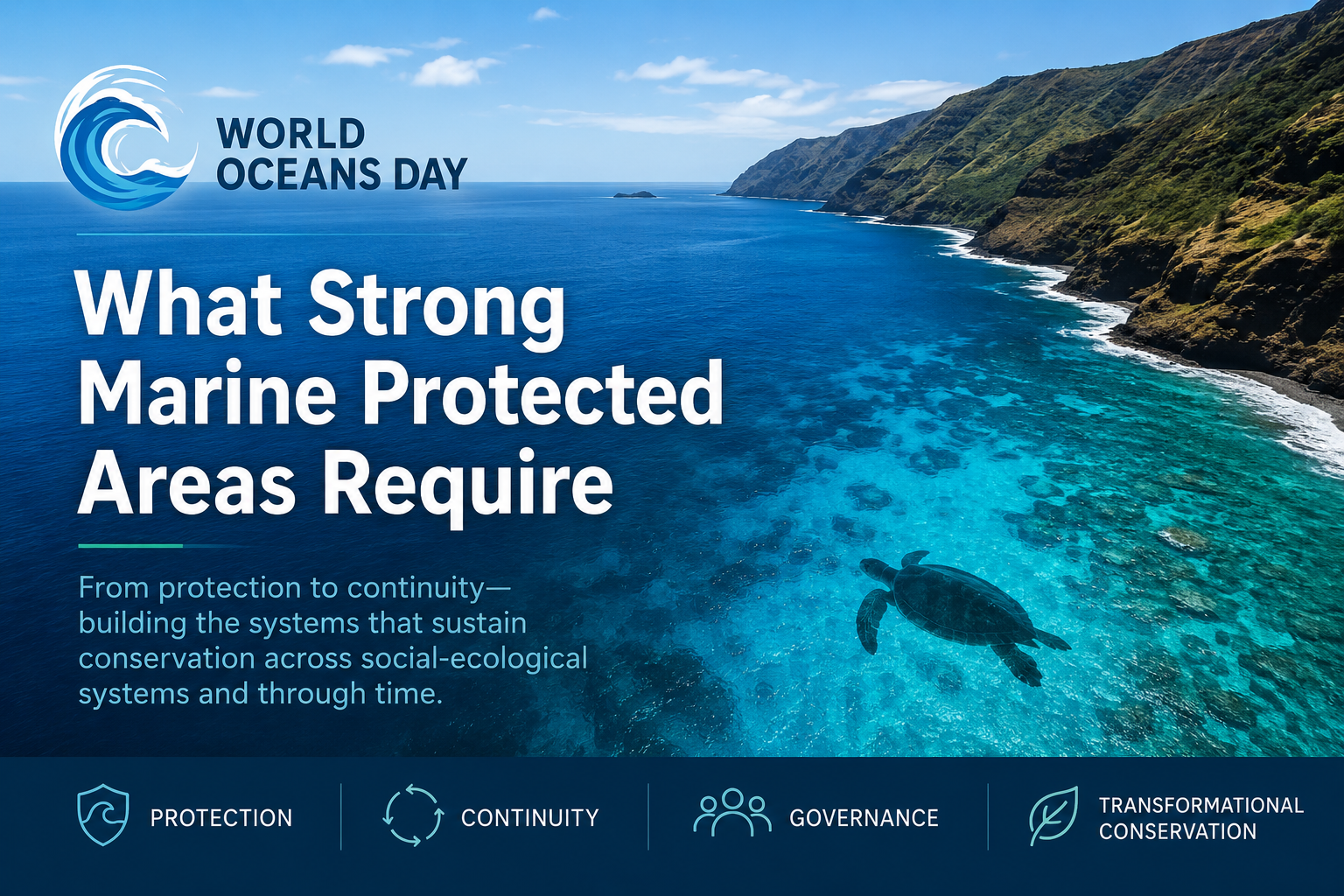
Each year on June 8, World Oceans Day encourages reflection on the importance of oceans and the role they play in sustaining life on Earth. This year's theme—Strong Marine Protected Areas for Our Blue Planet—highlights one of the most important tools available for ocean conservation (World Oceans Day, n.d.-a; World Oceans Day, n.d.-b).
The theme also raises an important question.
What makes a marine protected area “strong”?
At first glance, the answer may seem straightforward. Strong marine protected areas might be larger, more restrictive, or better funded. Those factors certainly matter.
Yet designation alone does not guarantee conservation outcomes. Marine protected areas vary considerably in their management approaches, conservation objectives, and levels of protection (Day et al., 2020; NOAA Marine Protected Areas Center, n.d.). A protected area is not automatically a strong protected area.
What ultimately distinguishes strong marine protected areas is not simply what they protect. It is their capacity to sustain conservation through time.
That requires more than boundaries on a map.
It requires stewardship: the ongoing work of sustaining conservation over time through design, planning, implementation, monitoring, evaluation, and revision as ecological and social conditions change.
Conservation does not end when a protected area is designated. In many respects, that is when stewardship begins.
Oceans Do Not Stop at Boundaries
Stewardship is necessary because marine protected areas exist within larger social-ecological systems that extend far beyond their designated boundaries.
Marine protected areas may have boundaries. Ocean systems do not.
Ocean currents move nutrients, organisms, and pollutants across vast distances. Fish populations migrate between protected and unprotected waters. Conditions within marine ecosystems are often shaped by activities occurring elsewhere (NOAA Ocean Explorer, n.d.; IUCN, n.d.-a). Decisions made outside a protected area can affect ecological conditions within it.
This interconnectedness is one reason marine conservation can be so challenging. Protected areas may conserve important places, but they remain embedded within larger ecological and human systems.
As understanding of these connections has grown, so too has recognition that effective conservation depends on more than protection alone. Long-term conservation depends on systems capable of responding to changing conditions and sustaining conservation objectives through time (IUCN, n.d.-a; IUCN, n.d.-b).
Strong marine protected areas, therefore, depend not only on what happens within their boundaries, but also on the capacity to sustain the broader social-ecological systems that influence them.
This reality became particularly clear to me while working on the management planning process for Papahānaumokuākea Marine National Monument.
A Lesson from Papahānaumokuākea
Earlier in my conservation career, I helped develop portions of the management plan for Papahānaumokuākea Marine National Monument, one of the world's largest marine protected areas (Papahānaumokuākea Marine National Monument, n.d.). As part of that work, I participated in multi-agency planning discussions involving federal agencies, Native Hawaiian representatives, scientists, managers, and other partners responsible for stewarding the monument's extraordinary ecological and cultural resources.
The meetings were often complex and contentious.
Different institutions brought different responsibilities and perspectives to the table. Questions about stewardship often required extensive discussion and negotiation. Reaching agreement was not always easy.
Yet those conversations were also necessary.
The experience reinforced a lesson that has remained with me ever since: conservation does not sustain itself simply because an area receives protected status.
The monument's ecological significance was not enough on its own. Sustaining conservation required continuity across institutions and through time.
What emerged from those discussions was more than a protected area. It was a system designed to sustain conservation through time.
That lesson extends well beyond oceans.
Beyond Oceans
The lesson of strong marine protected areas extends well beyond oceans.
Whether the goal is conserving biodiversity, restoring watersheds, or coordinating conservation across large landscapes, the underlying challenge remains the same. Conservation depends not only on protecting important places and resources but also on sustaining the systems that maintain conservation outcomes over time.
This is one reason environmental challenges are increasingly recognized as social-ecological rather than isolated. Ecological systems operate across landscapes and over long time horizons. Decisions affecting those systems are often distributed across multiple institutions and jurisdictions. As a result, conservation success depends not only on ecological knowledge but also on the ability to organize action across the systems that shape environmental outcomes.
The same lesson applies across conservation.
Many conservation systems remain fragmented relative to the scale and duration of the challenges they seek to address. Ecological processes routinely cross jurisdictional boundaries, while conservation decisions are often distributed across agencies, organizations, and sectors (IUCN, n.d.-a). Sustaining conservation across social-ecological systems increasingly requires institutions, governance systems, and decision processes capable of coordinating action at ecological scales and over long time horizons.
Protected areas, restoration, and species recovery remain essential. Yet long-term conservation depends on more than individual projects or protected places. It depends on the systems capable of sustaining and adapting conservation efforts as conditions change.
Transformational conservation ultimately depends on more than initiating conservation action. It depends on sustaining conservation objectives across social-ecological systems and through time. Continuity allows conservation efforts to build upon one another, adapt to changing conditions, and contribute to larger and more durable outcomes.
Why the Theme Matters
World Oceans Day was established to raise awareness of the importance of oceans and the challenges they face (World Oceans Day, n.d.-a). More than three decades after its creation, that purpose remains as important as ever.
Yet this year's theme points toward something deeper than awareness alone.
By focusing on strong marine protected areas, the theme encourages us to think not only about protection, but also about what protection requires. Conservation outcomes do not persist simply because boundaries are established or policies are adopted. They persist because continuity is maintained.
Awareness remains essential. Protection remains essential. Yet many of today's environmental challenges operate across social-ecological systems and over long time horizons that rarely correspond to individual jurisdictions, institutions, or sectors.
As a result, transformational conservation increasingly depends on continuity: the ability to sustain conservation objectives as ecological and social conditions change through time.
Continuity does not emerge automatically from protected area designation, restoration projects, or individual conservation initiatives. It depends on the institutions, governance systems, and decision processes capable of sustaining conservation across generations.
For marine and terrestrial social-ecological systems alike, that challenge increasingly points toward new forms of multi-jurisdictional, multi-sector, and multi-stakeholder conservation governance capable of coordinating action at ecological scales.
Strong marine protected areas remind us that conservation is not simply about protecting places. It is about building the continuity necessary to sustain conservation across social-ecological systems and through time.
Ultimately, transformational conservation depends on the institutions, governance systems, and decision processes capable of making that continuity possible.
It is a lesson worth reflecting upon this World Oceans Day.
References
Day, J., Dudley, N., Hockings, M., Holmes, G., Laffoley, D., Stolton, S., & Wells, S. (2020). Guidelines for applying protected area management categories to marine protected areas. International Union for Conservation of Nature.
International Union for Conservation of Nature (IUCN). (n.d.-a). Oceans and coasts. https://iucn.org/our-work/oceans-and-coasts
International Union for Conservation of Nature (IUCN). (n.d.-b). Ocean and climate change. https://iucn.org/our-work/topic/ocean-and-climate-change
NOAA Marine Protected Areas Center. (n.d.). Marine Protected Areas Center. https://marineprotectedareas.noaa.gov/
NOAA Ocean Explorer. (n.d.). Marine protected areas. https://oceanexplorer.noaa.gov/ocean-fact/mpas/
Papahānaumokuākea Marine National Monument. (n.d.). About the monument. https://www.papahanaumokuakea.gov/new-about/
World Oceans Day. (n.d.-a). Mission and history. https://worldoceanday.org/about/mission-history/
World Oceans Day. (n.d.-b). Strong Marine Protected Areas for Our Blue Planet. https://worldoceanday.org/take-action/action-theme/