🌎Earth Day Edition: From Federal Failure to a New Conservation Movement
How the breakdown of environmental governance is giving rise to place-based, self-directed action
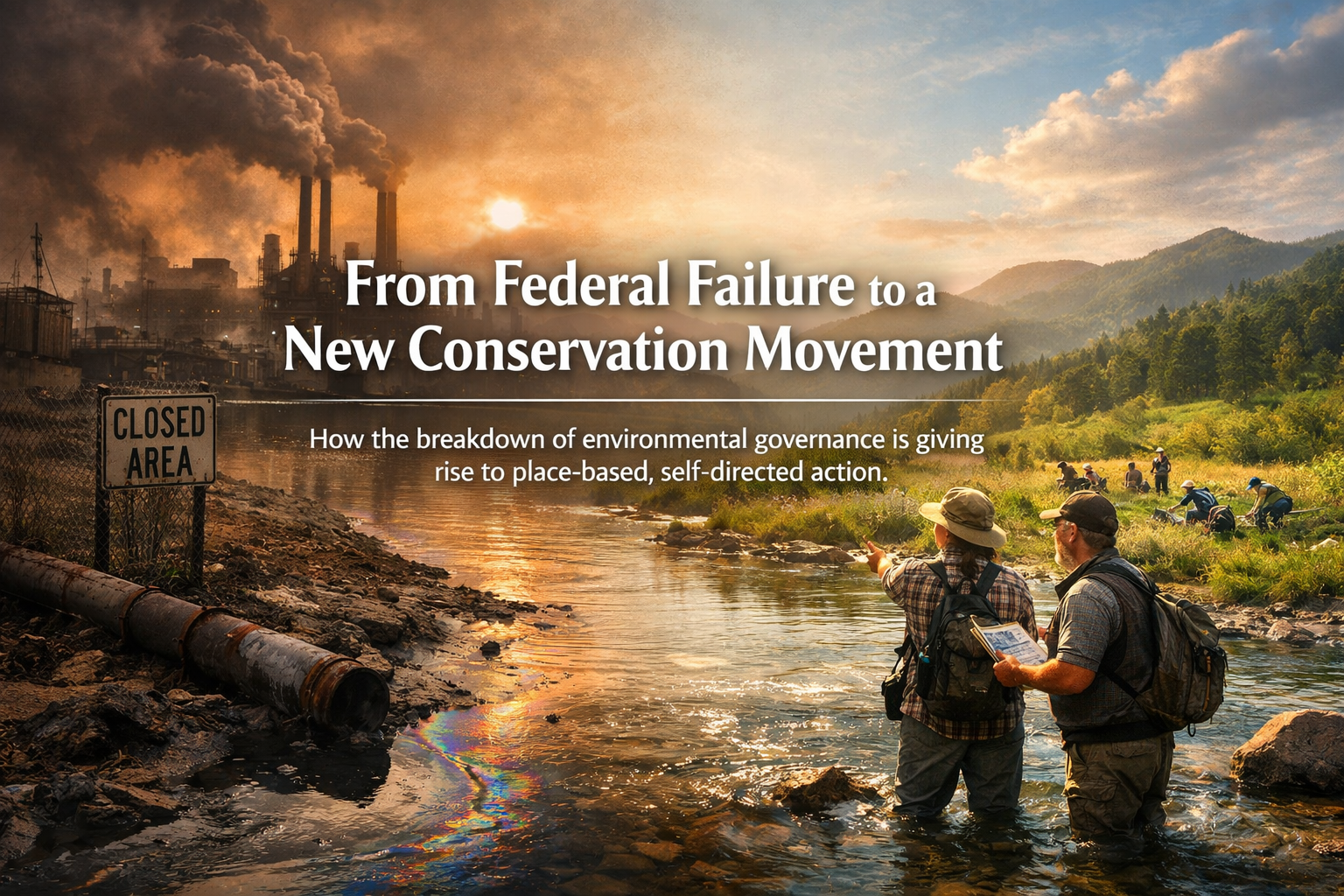
From Federal Failure to a New Conservation Movement
How the breakdown of environmental governance is giving rise to place-based, self-directed action
A System Developed in Response to Environmental Reality
The Emergence of Observable Environmental Conditions
The United States is approaching the 56th anniversary of Earth Day 1970 on April 22, a milestone that marked a significant shift in national understanding of environmental responsibility and stewardship.
In the years preceding this milestone, environmental degradation became increasingly tangible. Rivers ignited, oil contaminated coastlines, and visible air pollution enveloped urban areas. These phenomena spread regionally and became impossible to disregard.
Scientific Interpretation of Environmental Change
Scientific research provided clarity regarding observable environmental changes. Studies on pollution demonstrated that industrial discharge, nutrient runoff, and airborne contaminants were degrading ecosystems and reducing their capacity to sustain life, while also translating these changes into quantifiable risks to human health. Rachel Carson’s Silent Spring (1962) documented the effects of synthetic pesticides such as DDT, tracing their movement through ecosystems and accumulation in living organisms. These findings catalyzed public recognition of environmental risk and are widely credited with initiating the modern environmental movement, ultimately leading to the establishment of the U.S. Environmental Protection Agency (EPA). Previously isolated issues came to be understood as components of a single, stressed environmental system.
Transformation of Public Awareness into Collective Action
This understanding permeated public discourse, prompting widespread recognition and organization. The inaugural Earth Day mobilized millions, transforming environmental concern into collective advocacy and elevating environmental issues to national prominence.
Legislation Translated Recognition into Legal Obligation
The federal government responded by enacting major environmental legislation with broad bipartisan support, including the Clean Air Act of 1970 and the National Environmental Policy Act (NEPA). These statutes established mandatory requirements for action. For instance, NEPA obligated federal agencies to assess the direct, indirect, and cumulative impacts of their decisions, thereby institutionalizing environmental considerations within governance.
Establishment of an Institutional Response
These developments culminated in the establishment of the EPA under President Richard Nixon. The agency was created to protect human health and the environment, and to coordinate a comprehensive federal response. Its formation reflected widespread support for a unified national approach to environmental governance.
For a period, this system functioned as intended. Environmental conditions were identified, interpreted, and addressed through institutions specifically designed for such responses. The alignment between environmental reality and governance was maintained.
This alignment has since deteriorated.
Systemic Departure from Foundational Principles
This rupture is now explicit. The institution originally established to interpret environmental conditions is being led in a manner that diverges from its foundational purpose. Last week, EPA Administrator Lee Zeldin encouraged climate skeptics to “celebrate” their perceived vindication and has aligned with organizations such as the Heartland Institute, which has consistently challenged the global scientific consensus on climate change. These actions position the agency’s leadership in opposition to its scientific foundation, severing the connection between environmental conditions, scientific interpretation, and institutional response.
Governance Decoupled from Environmental Conditions
The EPA’s authority is grounded not only in regulatory power but also in its capacity to interpret environmental conditions through scientific analysis and translate that understanding into policy action. This responsibility currently resides with Lee Zeldin, who is charged with ensuring that decisions remain anchored to the environmental realities they are intended to address. Scientific evidence defines harm and establishes the criteria for action. In its absence, the EPA cannot effectively distinguish between acceptable and unacceptable conditions or justify its interventions.
This scientific foundation is now being disregarded. Zeldin recently repealed the endangerment finding, which is the legal determination that greenhouse gases threaten human health and welfare. These actions reinforce one another and prompt questions regarding the agency’s continued commitment to its scientific underpinnings.
The EPA remains operational: rules are proposed, standards are revised, and authority is exercised. However, the scientific basis that previously guided these decisions no longer determines their direction, resulting in an institution that persists in form but whose connection to environmental reality is weakening.
Institutional credibility diminishes when statements and actions diverge. At the EPA, this erosion is evident in both official rhetoric and organizational direction.
Emergence of Grassroots Environmental Action
The necessity for environmental governance persists even as government credibility declines. The conditions that prompted the creation of the EPA remain and are intensifying, yet federal leadership is no longer fulfilling its mandate. In response, self-directed conservation partnerships are emerging across regions. Stakeholders are advancing initiatives independently where federal institutions have failed to provide leadership.
These grassroots initiatives are producing tangible outcomes, yet they face inherent limitations. Decisions are frequently tailored to local conditions, as appropriate. However, many underlying processes, like climate change and habitat fragmentation, operate at regional scales, and decisions made in one locality may not translate elsewhere. In the absence of a unified structure, these efforts remain fragmented. The work persists, but it lacks a consistent framework to sustain it over time.
Constructing the Next Phase of Environmental Governance
Ecoregional Cooperatives (ECOs), as envisioned, offer a model for organizing governance at the scale of environmental processes. As proposed, ECOs would convene stakeholders within shared ecological regions to establish priorities and coordinate action. They would centralize the design and planning of landscape-scale systems, enabling integrated decision-making rather than fragmented efforts. While implementation would remain distributed, the guiding decisions would be developed and coordinated via deliberative, democratic processes, supplying the structural framework currently absent from most landscape-scale initiatives.
Participation would be organized around the people who live and work in the region and the shared purpose of sustaining those systems over time. ECOs would use structured processes to integrate scientific, technical, and local knowledge, evaluate alternatives, and produce coordinated outcomes that guide action across the region.
A New Conservation Movement
Governance models, like ECOs, do not just happen on their own. The shift from federal failure to place-based, self-directed action requires more than even local initiative. It requires governance to be deliberately designed to operate at the scale of the conditions it is meant to address, with the capacity to produce decisions, sustain them over time, and carry them across a landscape. That work is still in its early stages, but it is already defining what comes next.
The conditions that gave rise to Earth Day 1970 have not disappeared; in fact, they have intensified. Science continues to document rising temperatures, shifting precipitation patterns, ecosystem degradation, biodiversity loss, and growing risks to human health and livelihoods, whether federal institutions, like the EPA, accept the science or not. The question is no longer whether government will lead. It is who will take responsibility for building what comes next in its absence.
This is one thread of a much larger conversation.
If this blog resonates with you, read more at: www.designingnatureshalf.com