From Protest to Governance: Designing conservation systems for a changing planet
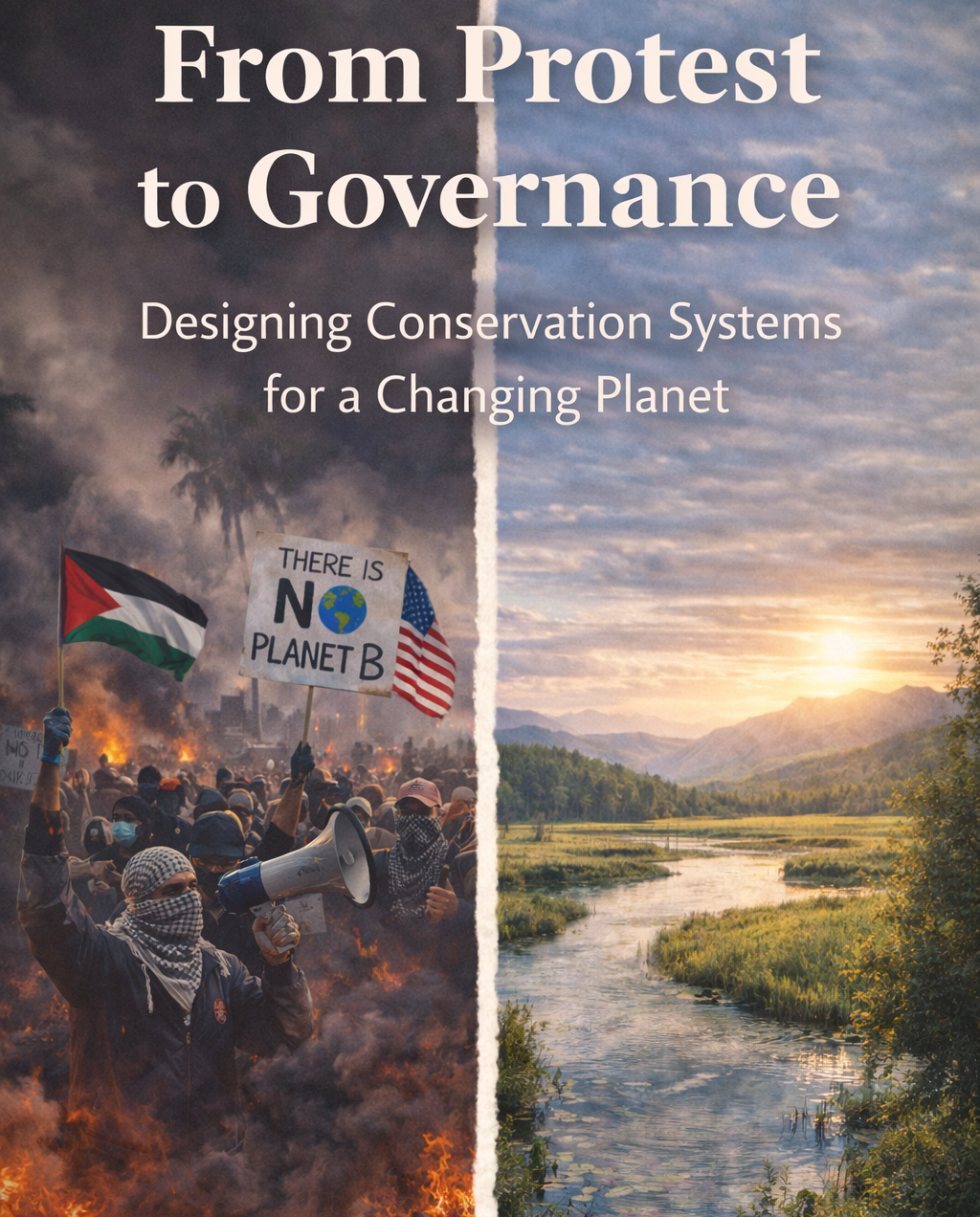
The United States just experienced its second-warmest winter on record. Globally, the last decade has been the hottest ever observed (more here). Conditions are shifting at every scale. The climate system that shaped modern conservation no longer exists. What comes next depends on how we respond—and who shapes that response.
Conservation in a Changing System
Conservation practice in the United States was built around environmental conditions that are no longer stable. Seasonal patterns that once anchored ecological processes—snowpack, runoff timing, freeze–thaw cycles—are shifting, and the systems they support are changing with them. This places conservation in a different position than it has occupied in the past. It is no longer working to protect systems within a stable range of variability. It is operating within systems that are actively transitioning.
Conservation Systems Out of Alignment
Taken together, the observed patterns indicate that the baseline itself is changing. The environmental conditions that shaped ecological systems—and the conservation practices built around them—are being replaced by a different set of conditions. This has direct implications for how conservation operates. Approaches developed under assumptions of relative stability are now being applied to systems that are no longer stable, with management strategies, planning frameworks, and institutions functioning under conditions they were not designed for. The issue is ecological change and conservation systems calibrated to a past that no longer exists.
Ecosystems will respond to these changes. The systems responsible for stewarding them must as well—or fail.
The System Is Being Driven in the Wrong Direction
The trajectory of environmental change is not neutral. It is shaped by political decisions, institutional priorities, and the use of power. In many cases, those systems are actively accelerating the problem. For instance, in the early weeks of the war on Iran, millions of tons of greenhouse gases were released, illustrating how quickly emissions can increase under conditions of conflict (more here).
Policy decisions can also move in maladaptive directions, redirecting substantial public resources away from renewable energy development and toward continued fossil fuel investment (more here). These are not accidental outcomes. They reflect deliberate policy choices that reinforce the interests of the oil and gas industry that helped bring the current administration to power.
These dynamics are not abstract. They are being reinforced through political decisions. The current Trump regime represents an effort to hold onto a past set of economic and political arrangements through power and intimidation, even as the environmental conditions that supported those arrangements continue to change.
This is active misdirection.
Institutional Failure and Public Response
At the same time, the institutions responsible for coordinating environmental stewardship are under increasing strain. Political polarization, declining regulatory capacity, and sustained attacks on government institutions have weakened the framework that once organized conservation in the public interest. The environmental system is changing rapidly, while the institutional system responsible for stewarding it is being dismantled.
These conditions are not unfolding without response. Across the country, millions of people have taken to the streets in large-scale protests and demonstrations (more here). Participation has expanded, drawing in people who had not previously engaged in civic action. The scale and geographic reach of these events reflect a broadening recognition that existing systems are not adequately addressing the challenges now unfolding.
Protest and boycott are necessary, appropriate, and just. They are an exercise of constitutional rights—freedom of expression, assembly, and dissent—particularly at a moment when those rights are being challenged by the very institutions meant to uphold them. They are also a signal. A signal that the public is not disengaged, and that the legitimacy of existing arrangements is being questioned in ways that extend beyond any single issue or event.
Democratic Expression and the Work Ahead
Democratic expression gives voice to public concern, builds solidarity, and can shift political pressure. But it does not, on its own, produce coordinated action across the landscapes and institutions where ecological systems are shaped.
The challenges now unfolding—climate change, ecological transition, and institutional instability—operate at scales that require organization, planning, and sustained coordination over time. Responding to those challenges means structuring collective action beyond institutions that have historically aligned such work, but are now being weakened or dismantled by the regime.
This is not a shift away from our constitutional or democratic rights, but an expansion of them. It is an expansion of what democratic participation must include within the conservation realm. We must exercise our rights—and we must build the systems through which those rights are translated into decisions, coordination, and long-term stewardship.
The In-Between Time as Design Space
We are living in a period between systems. The environmental and institutional conditions that shaped the past century are breaking down. The systems that will define the future have not yet taken form. The result is a period of instability, uncertainty, and transition.
This is the in-between time. A period of instability, uncertainty, and transition. Existing structures are weakening, and new ones have not yet been fully established. The direction of change is not predetermined. The trajectory is being shaped now through political decisions, institutional dynamics, and public action.
The current Trump regime represents an effort to hold onto the past through power and intimidation, even as the environmental conditions that supported that past continue to erode. It is an attempt to maintain systems that no longer align with a changing planet. But this moment is not defined only by what is being resisted. It is also defined by what can be created.
We must take advantage of this in-between time to design and build an alternative social-ecological system—one capable of functioning within, and despite, the uncertain future we now face. The conservation and sustainable use of ecosystem services must form the foundation of that system. These are the processes that sustain life, structure ecosystems, and support human communities. Any viable future must be organized around their long-term stewardship.
Future generations depend on our success.
The Required Response
What is needed is not simply reform, but transformation to a different kind of system entirely.
Within the conservation realm, that system must operate at the scales where ecological processes actually function: landscapes. It must extend across jurisdictions, connecting federal, state, tribal, and local authorities with multiple sectors—agriculture, forestry, energy, water, transportation, and housing—and stakeholders, including private landowners and communities whose decisions shape the same landscapes. It must be collaborative, participatory, and deliberative, grounded in democratic processes that allow diverse interests to be represented and negotiated over time.
These requirements are not theoretical. They reflect the conditions under which conservation already operates—across fragmented jurisdictions, competing land uses, and interconnected systems that cannot be addressed in isolation.
Most importantly, this system must be designed.
It will not emerge from existing arrangements or incremental adjustments to institutions built under conditions that no longer exist. It must be intentionally constructed as a social-ecological system—one that designs sustainable landscapes for both people and nature. One that supports communities ecologically, economically, and democratically within and across landscapes. This requires forms of organization capable of coordinating action within and across landscapes, enabling participation, deliberation, and shared decision-making beyond existing institutional constraints.
This is the work ahead for the conservation community if it intends to remain relevant and effective during a time of global change.
A Political Foundation
The system described here does not emerge without a political foundation. Ecosocialism (also spelled eco-socialism) provides that foundation.
Eco-socialism begins from a simple premise: ecological systems set the conditions for human life, and economic activity must operate within those limits. It rejects an economic model built on extraction, accumulation, and endless growth, and instead centers democratic control over the systems that shape land, energy, and resources.
This has direct implications for conservation.
Conservation cannot function as a separate domain while the broader economic system continues to degrade the conditions it depends on. It must be integrated into how societies organize land use, production, infrastructure, and resource allocation across entire landscapes. This requires democratic governance at scale.
Eco-socialism calls for collective control over land, water, energy, and ecosystems—not as commodities, but as shared systems to be stewarded over time. It emphasizes participation, deliberation, and accountability in how those systems are managed, particularly for the communities whose lives are directly tied to them. These principles are visible in movements calling for public ownership of energy systems, just transitions for workers, and the protection of common resources. But they must extend further.
They must extend to the design of landscapes.
Ecological systems do not operate within political boundaries or sectoral silos. They function across regions, connecting watersheds, habitats, economies, and communities. Managing those systems requires institutions capable of coordinating across those realities, not within fragmented jurisdictions or isolated sectors. This is where eco-socialism must move from principle to structure. That structure does not yet exist at the scale required, but it can be built.
From Expression to Construction
We are not short on awareness. People understand that something is wrong and are acting on that understanding—organizing, protesting, boycotting, and demanding change. These actions are necessary, appropriate, and just. They are an expression of democratic rights at a moment when those rights are under pressure.
But expression is not construction.
The systems that shape landscapes, economies, and ecological futures are not replaced through opposition alone. They are replaced by building something that can function in their place. That is the work in front of us.
We are living in a moment where the old system is being defended through power, even as it fails to align with the conditions of a changing planet. The Trump regime is not an anomaly in that sense. It is an attempt to preserve an economic and political order that no longer fits the ecological reality it depends on. What comes next is not predetermined.
It will be shaped by what is built during this in-between time—by whether democratic energy is translated into institutions capable of organizing collective action at the required scale. That means moving from protest to governance.
It means grounding conservation in systems that operate across landscapes, coordinate across sectors, and persist over time. It means aligning ecological reality with institutional capacity. It means building a social-ecological system that can sustain both people and nature under conditions that are no longer stable.
The public is engaged. The moment is open.
What comes next depends on what we build—together, for all.
Check out these links for more information on eco-socialism and the Democratic Socialists of America.
If this work resonates with you, subscribe at https://designingnatureshalf.com to receive new essays as they are published.
This work continues in public.