The Planet Has Already Changed. So Must We.
What a lifetime of winter warming reveals about the future of conservation
The United States just experienced the second-warmest winter ever recorded, according to the National Oceanic and Atmospheric Administration’s 131-year climate record. Two of the warmest winters in U.S. history have now occurred within the past three years.
Headlines like these often generate confusion because cold spells still occur. Arctic air can still sweep south. Snowstorms still blanket large parts of the country. But individual weather events do not define climate trends. The long-term temperature record tells a much clearer story.
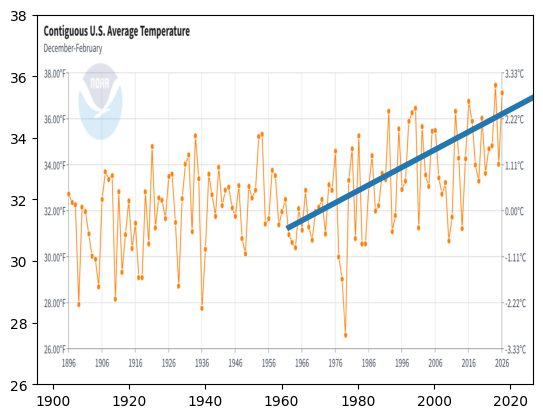
Figure 1. Average winter temperatures across the contiguous United States have increased by approximately 4.2°F since 1962, warming at a rate of about 0.66°F per decade. The figure illustrates how the climatic baseline experienced within a single lifetime has shifted measurably. Data: NOAA National Centers for Environmental Information.
When that record is viewed across a human lifetime, the magnitude of change becomes difficult to ignore. Since 1962—the year I was born—average winter temperatures across the contiguous United States have risen by more than four degrees Fahrenheit, warming at a rate roughly 160 percent faster than the long-term historical trend.
In other words, the climate system many of us were born into no longer exists.
Climate Change During One Lifetime
Viewing climate change across a human lifetime provides a useful perspective on its pace. The winter temperature record for the contiguous United States shows a clear upward trend beginning in the mid-twentieth century. When examined from 1962 to the present—the span of a single lifetime—the pattern becomes especially striking.
Since 1962, average winter temperatures across the United States have increased by approximately 4.2°F, warming at a rate of about 0.66°F per decade. This rate of warming is roughly 160 percent faster than the long-term trend observed across the entire historical record beginning in the late nineteenth century.
Seasonal warming of this magnitude carries important ecological implications. Winter conditions shape many of the processes that structure ecosystems, including snowpack accumulation, the timing of spring runoff, soil freeze–thaw cycles, and the seasonal dynamics of plant and animal populations. Shifts in winter temperatures can therefore influence everything from water availability to species distributions across landscapes.
These changes are not abstract projections about the distant future. They are already visible in the historical record. Over the course of a single lifetime, the climatic baseline that underpins ecological systems across much of the United States has shifted measurably.
For conservation practitioners, this raises a fundamental question: if the environmental systems we are trying to steward are already changing so quickly, how should conservation itself respond?
What the Temperature Record Reveals
Looking beyond the perspective of a single lifetime, the broader structure of the temperature record reveals several important patterns.
First, the long-term trend is unmistakable. Since the late nineteenth century, winter temperatures across the contiguous United States have steadily increased. Year-to-year variability remains large—some winters are cold, others mild—but the overall trajectory moves consistently upward.

Figure 2. The winter temperature record for the contiguous United States from 1895 to the present reveals a persistent long-term warming trend and an increasing concentration of the warmest winters in recent decades. Data: NOAA National Centers for Environmental Information.
Second, the pace of warming has accelerated in the modern era. When the temperature record is divided into shorter time windows, the trendline's slope becomes noticeably steeper after the mid-twentieth century. In other words, the rate of warming observed during the past several decades is significantly faster than the average rate calculated across the entire historical record.
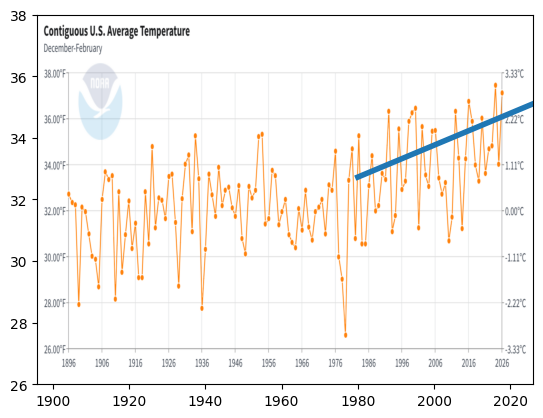
Figure 3. Winter temperatures across the contiguous United States from 1980 to the present show a steeper warming trend than the long-term historical record, indicating accelerated climate warming in recent decades. Data: NOAA National Centers for Environmental Information.
Third, many of the warmest winters occur within the most recent portion of the dataset. As new observations are added each year, they increasingly cluster toward the upper end of the historical range. The second-warmest winter on record, which just occurred, is part of this broader pattern rather than an isolated anomaly.
Taken together, these observations suggest that the climate system is not simply fluctuating around a stable baseline. The baseline itself is shifting. The environmental conditions that shaped ecological systems throughout much of the twentieth century are gradually being replaced by a different climatic regime.
For conservation practitioners, this matters because ecological systems are structured around long-term environmental patterns. When those patterns begin to change, the assumptions underlying many conservation strategies must change as well.
Why This Matters for Conservation
The temperature record is more than a scientific dataset. It describes the environmental conditions within which ecosystems operate. When those conditions begin to change, the systems that depend on them change as well.
For much of the twentieth century, conservation institutions operated within relatively stable climatic conditions. Protected areas were established, species recovery programs were developed, and land and water management frameworks evolved around environmental patterns that were assumed to persist over time. While variability was always present, the underlying climatic baseline remained comparatively stable.
That assumption is becoming increasingly difficult to maintain. As winter temperatures rise, the ecological processes shaped by seasonal cycles are beginning to shift. Snowpack accumulates differently. Spring runoff occurs earlier in many regions. Species distributions move as organisms track changing temperature and habitat conditions across landscapes.
These changes do not render conservation impossible, but they do complicate it. Strategies designed for past environmental conditions may not function the same way under the conditions emerging today. The challenge is not simply protecting ecosystems as they exist today, but stewarding landscapes through a period of accelerating environmental change.
For conservation practitioners, this raises a fundamental question: if ecological systems are already shifting in response to climate change, how should conservation strategies adapt?
The Institutional Problem
Responding to environmental change at the scale at which ecosystems actually operate presents a challenge that is both ecological and institutional.
The first challenge is one of scale. Ecological systems function across landscapes, watersheds, and ecoregions. Wildlife populations move across large geographic areas. Rivers connect upstream and downstream environments. Seasonal processes such as snowpack accumulation and spring runoff influence entire watersheds. Yet many conservation decisions are still made within the boundaries of individual jurisdictions, agencies, or projects. Federal agencies manage public lands, states oversee wildlife and water policy, local governments control land use, and private landowners manage much of the landscape between these jurisdictions. Each actor makes decisions within its own authorities and mandates.
The result is a familiar pattern: conservation actions that may succeed locally but remain fragmented at the scale of the ecological systems they are intended to protect.
A second challenge is becoming increasingly difficult to ignore. Many of the public institutions historically responsible for stewarding environmental resources are weakening at the very moment their role is becoming more important. Political polarization, declining regulatory capacity, and sustained attacks on environmental governance have eroded parts of the institutional framework that once helped coordinate conservation efforts in the public interest.
For much of the twentieth century, conservation relied heavily on them. Federal and state agencies provided scientific capacity, regulatory authority, and long-term continuity in environmental stewardship. While these institutions were never perfect, they created a governance framework capable of organizing conservation action across large portions of the landscape, though admittedly in an ad hoc manner.
That framework is becoming increasingly less effective. Budget cuts, political interference, institutional fragmentation, and declining public trust have reduced the ability of many agencies to act at the scale and with the consistency required for large-landscape stewardship.
Taken together, these two trends—the scale mismatch between ecosystems and governance, and the weakening of the institutions historically responsible for environmental stewardship—create a difficult situation for conservation practitioners. Ecological systems are changing rapidly and operate across large landscapes, yet the institutional capacity to coordinate responses across them is increasingly uncertain.
The environmental system is changing rapidly, while the institutional system responsible for stewarding it is becoming less stable.
If conservation is to operate effectively under these conditions, new methods will be necessary—methods that work across landscapes while maintaining legitimacy, public participation, and long-term stewardship.
A Regional Democratic Response
In last week’s essay, I described the present moment as an “in-between time”—a period when existing systems are clearly under strain, but the institutions that will shape the future have not yet taken form. Moments like this can be unsettling, but they also create space to think more seriously about how societies might organize themselves differently.
If conservation is to operate effectively amid rapid environmental change and institutional uncertainty, new forms of coordination may be required. One possibility is to organize stewardship more deliberately at the scale at which ecosystems operate: landscapes and ecoregions.
This is the idea behind Ecoregional Cooperatives. Rather than relying exclusively on fragmented jurisdictional authorities, Ecoregional Cooperatives would function as democratic regional institutions designed to coordinate conservation and sustainable development across entire socio-ecological landscapes.
Their role would not be to replace existing agencies, landowners, or enterprises. Instead, ECOs would provide the institutional framework through which regions can design sustainable landscape futures and coordinate the integration of conservation, restoration, land use, and economic activity within ecological limits.
In this model, regional stakeholders—including public agencies, tribes, local governments, scientists, conservation organizations, landowners, and residents—would work together to negotiate how land, water, biodiversity, restoration, and development interact across the landscape. The goal is not simply to understand ecological systems, but to design socio-ecological systems capable of sustaining both nature and human communities over time.
Tools such as landscape conservation design (LCD) would support this process by integrating ecological and social sciences, spatial analysis, and stakeholder knowledge to explore plausible landscape configurations and develop strategic plans at the landscape scale. In this framework, landscape conservation is the practice, LCD is the design methodology, and Ecoregional Cooperatives provide the democratic institutional architecture capable of organizing and sustaining that work at the regional scale.
Ideas like this are not presented as immediate policy blueprints. They are part of a longer conversation about what conservation might need to look like in the years ahead as the current condition continues to unravel. Periods of institutional uncertainty—the kind of “in-between time” we are living through now—are often when societies begin imagining the institutions that will define the next era of stewardship.
Designing Conservation for a Different Planet
The climate record now makes something clear: the environmental conditions that shaped conservation during much of the twentieth century are already changing. Within a single lifetime, the baseline climate of the United States has shifted measurably, altering the ecological systems conservation is meant to steward.
Yet the institutional structures responsible for organizing that stewardship remain largely rooted in the assumptions of an earlier era. Conservation still relies heavily on governance frameworks designed for a more stable environmental context.
If the planet has already changed, the systems responsible for stewarding it must evolve as well. The question is not only how ecosystems will respond to environmental change, but how societies will organize themselves to care for those systems under new conditions.
That is ultimately the challenge explored in my upcoming book, Designing Nature’s Half: An Architecture for Conserving 50% by 2050. Imagining institutions capable of sustaining conservation across landscapes in a rapidly changing world.