

AI Is Infrastructure: From Project Planning to Landscape Design
What the United Nations University's new report on AI reveals about the future of landscape-scale decision-making.
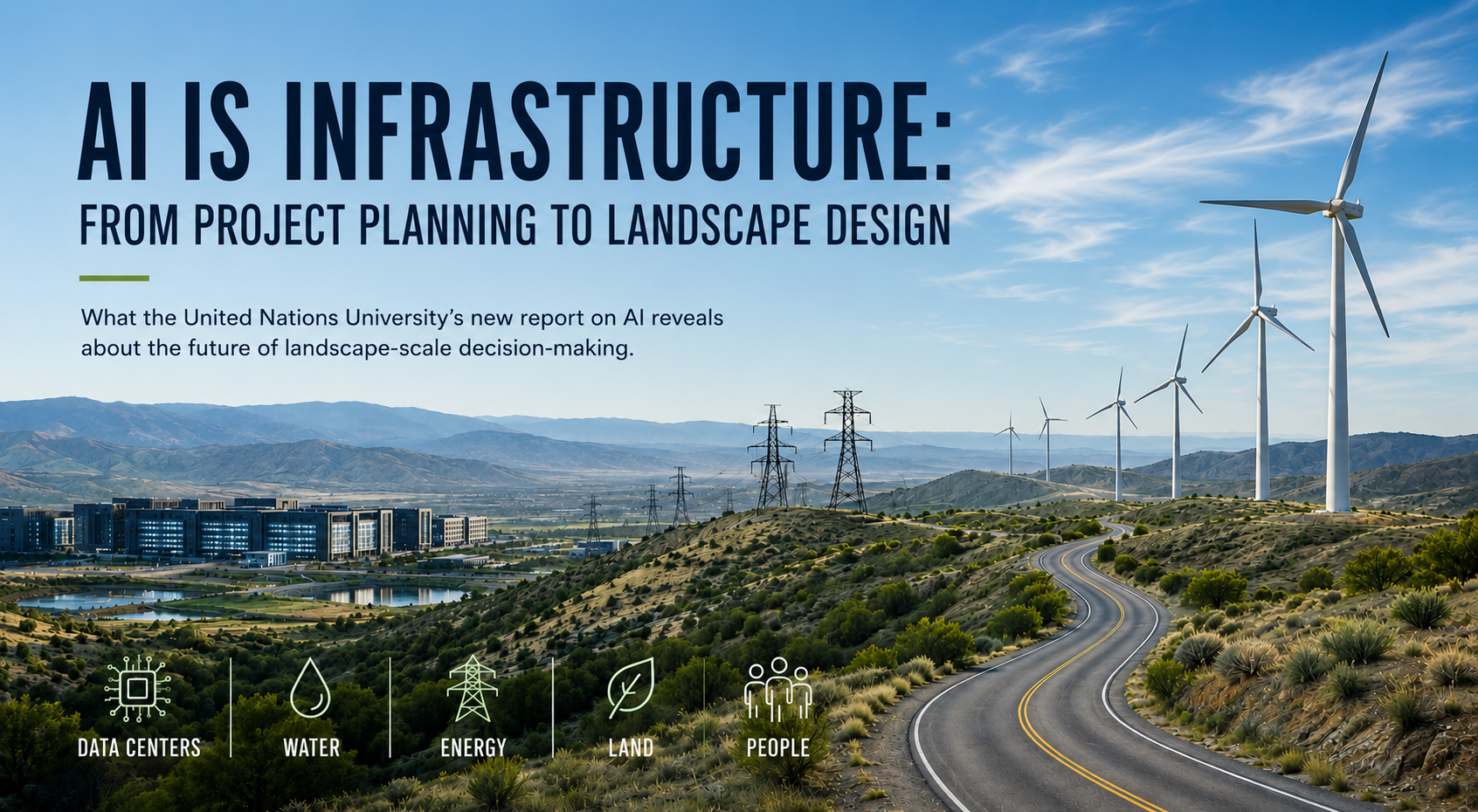
Who Designed This Landscape?
When I submitted the completed manuscript of my book, Designing Nature’s Half: An Architecture for Conserving 50% by 2050, to my editor earlier this month, I found myself with an unexpected but welcomed opportunity to step away from the project for a short while.
For the past couple of years, much of my attention has been devoted to researching, writing, revising, and refining the manuscript. With it now in my editor’s hands, I decided to take advantage of the pause by traveling from New Mexico to Washington, D.C., in CAV—the Camp Alone Van—my DIY campervan COVID project.
Long road trips have a way of changing how you see landscapes.
Somewhere along the journey, I began noticing something that became increasingly difficult to ignore. Wind turbines appeared across the horizon. Then more. Then entire wind farms stretching across landscapes in state after state. Individually, none of them seemed particularly remarkable. Collectively, however, they raised a question that stayed with me for the rest of the trip.
Was the landscape I was driving through ever intentionally designed, or had it simply emerged from thousands of individual project decisions made over many years?
It wasn’t a question about wind energy. Renewable energy remains an essential part of the transition toward a lower-carbon future. It was a question about how landscapes are shaped.
That question took on new significance when I began reading a recently released United Nations University report, Environmental Cost of Artificial Intelligence: Carbon, Water, and Land Footprints.
At first glance, the report appears to be about artificial intelligence (AI). In fact, it is about something much larger.
AI Is Infrastructure
AI is often discussed as though it exists entirely in the digital world. The UNU report argues otherwise. Its central contribution is reframing AI as physical infrastructure rather than simply documenting its environmental impacts.
AI is infrastructure. It depends on data centers and transmission systems, critical minerals and semiconductor manufacturing, electricity generation and cooling technologies, freshwater, and, as it relates to my expertise and this blog, land.
That distinction matters.
Infrastructure does not simply occupy individual sites. Over time, it reshapes landscapes. It influences where electricity is generated, where transmission lines are built, where water is withdrawn, and where social-ecological systems experience new pressures.
The report, therefore, recommends incorporating AI into environmental planning. I believe that recommendation is exactly right, but it also points toward a larger question.
If AI is infrastructure—and if that infrastructure will reshape landscapes through its demands for transmission, energy, water, and land—then perhaps planning individual projects is no longer enough.
Infrastructure is planned one project at a time, but we experience infrastructure projects within the context of landscapes. Increasingly, our environmental decision systems must operate at the same scale as the landscapes they collectively shape.
We Don't Design Landscapes
That idea sits at the heart of Designing Nature's Half, my forthcoming book on landscape conservation design (LCD)—an architecture for moving conservation from project-by-project planning to intentional landscape design.
The central idea behind the book is surprisingly simple.
We don’t design landscapes. We plan individual projects.
Housing and other development projects. Highways and roads. Wind farms and transmission lines. Now, increasingly, data centers.
Each project may be thoughtfully planned, carefully reviewed, and entirely reasonable on its own.
The landscapes we inherit are not the product of intentional landscape design. They are the cumulative result of decades of project-by-project decisions.
AI, despite its numerous faults, presents us with an opportunity to rethink how landscapes are shaped.
We cannot redesign the Interstate Highway System, the national transmission grid, or much of our existing development pattern. Those landscapes already reflect decades of project-by-project decisions.
AI infrastructure is different. It is still being built.
That gives us an opportunity to ask landscape-scale questions before hundreds of new projects accumulate into another generation of infrastructure.
Where should new data centers be encouraged? Where should they be discouraged? How should their energy demands influence electricity generation, water resources, conservation priorities, environmental justice, and future development across the same landscape?
Those are not simply questions about individual projects. They are questions about landscapes.
Landscape conservation design (LCD) begins with those questions. It asks how a landscape should function before individual projects are planned so that planning, permitting, and environmental review occur within a shared landscape vision rather than gradually determining that vision one project at a time.
Transforming Conservation
Transformational conservation requires something more fundamental.
It requires transforming the way we make landscape-scale decisions.
For more than half a century, environmental law has become increasingly sophisticated at evaluating individual projects. Environmental impact assessment, public participation, permitting, and mitigation have significantly improved project-level decision-making.
Those advances should continue.
But today’s environmental challenges—including AI infrastructure, renewable energy, water security, pollution, biodiversity loss, and climate adaptation—do not unfold one project at a time.
They unfold across social-ecological systems whose boundaries rarely correspond with jurisdictions, agencies, or permitting authorities.
If our environmental challenges operate at landscape scales while our decision systems remain organized primarily around individual projects, then we should not be surprised when landscapes emerge that no one intentionally designed.
That may be one of the defining conservation challenges of the twenty-first century.
Landscape conservation design offers one response. It complements planning, environmental review, and permitting by asking a different question before those processes begin:
How should this landscape function, and how can hundreds of future decisions contribute to that vision rather than gradually defining it through project-by-project approvals?
AI will not be the last technology to reshape our landscapes. Whatever comes next—advanced manufacturing, new energy systems, carbon removal, water infrastructure, or technologies we have not yet imagined—the same challenge will remain.
Our environmental challenges increasingly operate at landscape scales.
If conservation is to become truly transformational, our decision systems must be as well. That means asking more than whether individual projects should proceed. It means asking how hundreds of future decisions will collectively shape the landscapes they share.
The United Nations University report reminds us that AI is infrastructure. Perhaps its broader contribution is reminding us that infrastructure ultimately becomes landscape.
We don’t design landscapes. We plan individual projects.
Perhaps it is time to begin doing both.