🌎Designing the Future in the In-Between Time
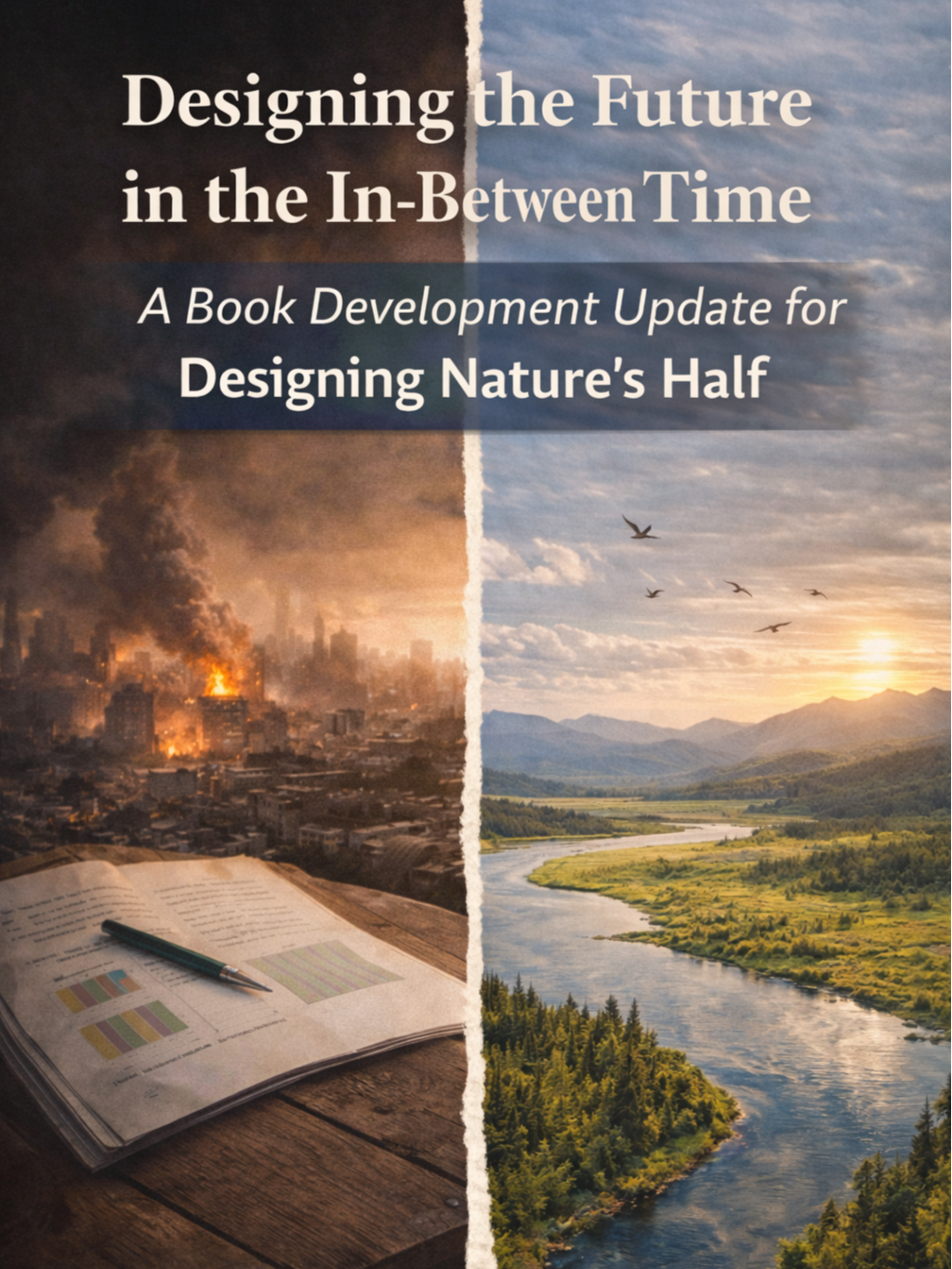
More than a week into the American–Israeli war on Iran, over 1,500 innocent Iranian civilians have already lost their lives in an unprovoked war. It follows on the heels of the war in Gaza, where more than 72,000 Palestinians have been killed and countless others displaced. The human and environmental costs of war are once again unfolding before the world.
It is precisely during turbulent periods like these — at home and abroad — that we step back from the immediate crisis and take the time to think beyond the current state of affairs. This is the in-between time: when we begin mapping the future we want while the present unravels. Now is when serious planning must occur so that when circumstances eventually shift — and they will — we are prepared to build what we’ve designed.
Work on Designing Nature’s Half belongs to this in-between time. The book examines how landscapes are stewarded over long time horizons and how deliberate design can shape the future before decisions fragment ecosystems and communities.
In this update, I want to briefly share where the project stands: what’s behind me, where I am now in the manuscript, and what I’m working on next.
What’s Behind Me — Building the Case for Landscape Conservation Design
The early chapters of the book focus on building the case for landscape-scale conservation and design.
They begin by situating conservation within what many scientists now describe as the triple planetary crisis: climate boiling, biodiversity loss, and pollution. These are not distant projections but accelerating realities reshaping ecological systems across entire regions.
In this context, the book argues that incremental conservation is no longer sufficient. Protected areas, restoration projects, and species management remain essential tools, but most were developed for a world in which ecological systems were changing more slowly, and human infrastructure was less pervasive.
Today, the scale and pace of ecological degradation require something more transformative. A well-coordinated, collaborative conservation approach must operate across landscapes rather than isolated sites.
This shift raises the question of scale. Science conducted over the past six decades, including research in landscape ecology, conservation biology, and systematic conservation planning, suggests that sustaining ecological processes requires conserving far more than scattered fragments of habitat. Proposals such as Half Earth reflect a broader recognition that ecological systems require sufficient space to function over time.
But operating at this scale introduces a new challenge. Landscapes must simultaneously accommodate biodiversity conservation, working lands, infrastructure systems, climate adaptation, and human livelihoods. These competing demands cannot be reconciled through isolated projects or sequential permitting decisions.
Landscape conservation design (LCD) provides a way to address this challenge. It creates a structured process that allows diverse actors to express their interests, examine alternative landscape configurations, understand trade-offs, and collectively pool their resources to shape landscapes that benefit people and the ecosystem services they depend on.
The question is no longer whether landscape conservation is necessary. The question becomes how landscape conservation design actually works.
Where I Am Now — Developing the Architecture of Landscape Conservation Design
Landscape-scale conservation is widely recognized as necessary, but it is difficult to implement in practice. Landscapes cross political jurisdictions, ownership patterns, economic sectors, and institutional mandates. Decisions affecting ecological systems are therefore rarely made at the scale where those systems function.
Instead, landscapes are shaped through a sequence of fragmented decisions made by actors operating within their own authorities and timelines. Agencies manage their mandates, industries pursue development opportunities, and landowners make individual land-use choices. Over time, these decisions accumulate, gradually reorganizing landscapes without deliberate coordination.
Much of the work behind me in the manuscript has focused on building the analytical foundation needed to address this challenge.
Two chapters form the scientific core of LCD. Interdisciplinary Assessment (Chapter 5) integrates ecological, social, economic, and institutional knowledge to build a shared understanding of landscape systems and plausible future conditions. Interactive Spatial Design (Chapter 6) builds on traditions of spatial conservation planning, allowing landscape stakeholders to explore how different priorities reorganize landscapes across space.
Building this analytical foundation has required careful attention to the strength of the evidence supporting each component of the framework.
Last month, I rewrote Chapters 5 and 6 because I wasn’t satisfied with the sources supporting several claims in them. The arguments themselves remained intact, but the evidentiary foundation needed to be stronger. I conducted new literature searches and rebuilt both chapters around stronger Tier-1 anchors. Rewriting them was exhausting; finishing them was a relief.
With the analytical foundation largely in place, the manuscript is now entering its next phase. The central question shifts from how we understand landscapes to how societies act on that understanding.
What I’m Working On Next — Governance and Implementation
Understanding landscapes is only part of the challenge. Landscape conservation design can clarify priorities, reveal trade-offs, and identify opportunities for collective action. But design alone does not transform landscapes.
Implementation requires institutions capable of sustaining shared decision-making over time.
This is where the manuscript now turns. The next chapters examine how insights from spatial design translate into strategy design. Strategy Design (Chapter 7) is the process through which landscape stakeholders negotiate who does what across a shared geography to move toward a desired future state. The result is a collaboratively developed strategic plan that clarifies responsibilities across agencies, organizations, communities, and landowners. Each participant can then use that shared strategy to develop their own implementation and action plans.
Once strategies are established, however, a deeper question emerges: who sustains the work?
Landscape conservation operates across fragmented institutions: federal agencies, state governments, tribal nations, local jurisdictions, private landowners, and industry. Collaborative initiatives often succeed during initial planning phases but struggle to persist once projects move into implementation. Without durable governance structures, landscape-scale efforts frequently dissolve as leadership changes, funding cycles end, or institutional priorities shift.
The final chapters of the book, therefore, move from design methodology to institutional architecture. They explore how democratic regional institutions might sustain landscape stewardship across generations.
One possible approach examined in the manuscript is the concept of Ecoregional Cooperatives. These institutions are envisioned as democratic regional design and planning cooperatives operating at the ecoregional scale. Rather than replacing existing authorities, they would provide an institutional structure where conservation, production, and development decisions can be deliberated and designed across landscapes.
The aim is not simply better design and planning. It is the institutionalization of transformational conservation.
Designing institutions capable of stewarding landscapes across generations is not quick work. It happens during the in-between time, when the future is still taking shape, and serious planning becomes possible.
That is the phase this manuscript is now entering.