🌎From Designing Landscapes to Keeping the Doors Open
What the dismantling of conservation capacity at the U.S. Fish and Wildlife Service tells us about what conservation must build next
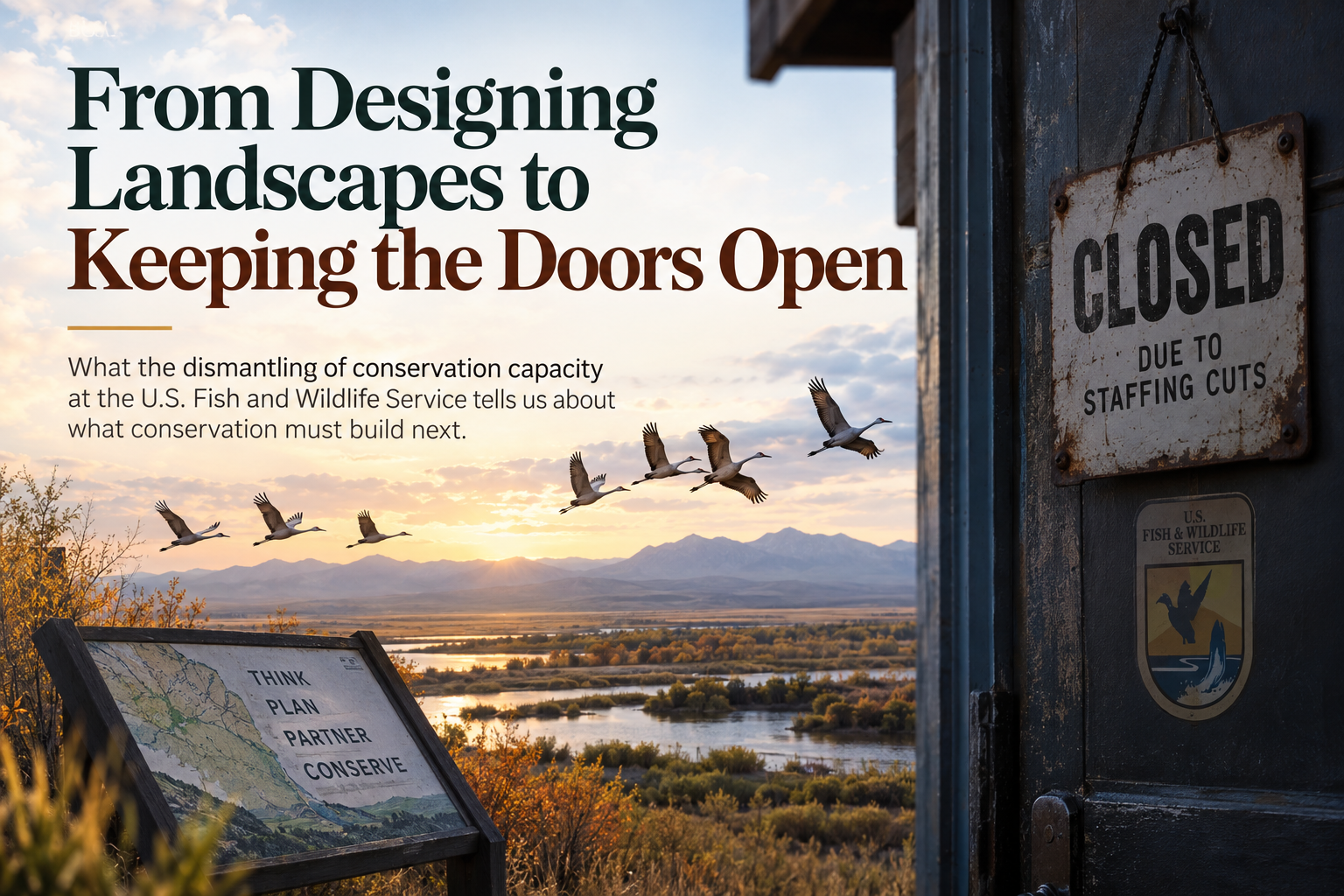
The U.S. Fish and Wildlife Service (USFWS) is losing people. Lots of important, intelligent, and passionate people.
Biologists. Refuge managers. Scientists. Planners. Maintenance professionals. Administrative staff. People with years—typically decades—of knowledge about species, places, communities, and conservation programs.
A recent Our Public Lands & Waters article, “U.S. Fish and Wildlife Service Has Lost 36% of its Workforce Under the Second Trump Administration,” documents the scale of what is happening across the agency.
For me, this one is personal.
Building for the Future
I spent roughly twenty-five years working in federal conservation, first with the National Park Service and then for most of my career with USFWS's National Wildlife Refuge System (NWRS). And I remember when NWRS was trying to build something very different.
In 2010, I was Regional Planning Chief responsible for refuge planning across Arizona, New Mexico, Oklahoma, and Texas. We were testing a new landscape scale approach involving roughly forty national wildlife refuges across the Southwest.
Refuge planning had understandably focused primarily on individual protected areas. Climate change was exposing the limits of thinking one refuge at a time. Wildlife moved across refuge boundaries. Fire, drought, development, invasive species, and climate change reshaped entire landscapes.
So we began asking a bigger question:
How could refuges work with partners across entire landscapes to sustain wildlife and ecological systems under accelerating change?
That work eventually took me to USFWS headquarters outside Washington, D.C., where I was asked to help develop a national landscape approach to NWRS planning.
It was both an honor to serve in such a capacity, and a challenge.
Our landscape approach became known as landscape conservation design (LCD).
A conservation institution more than a century old was asking how individual refuges could become anchors for conservation across entire landscapes. Agencies, Tribal Nations, landowners, scientists, conservation organizations, communities, and others could work together to understand changing conditions and develop shared conservation direction across jurisdictional boundaries.
NWRS was trying to reinvent itself for the conservation challenges of the twenty-first century.
Taking It Apart
Then Donald Trump took office.
His first administration dismantled the Landscape Conservation Cooperatives (LCCs) that had become an important part of the country's emerging landscape conservation architecture. LCD lost much of the federal institutional structure that had supported it. The administration also began its initial attack on Bears Ears National Monument and the experiment in collaborative Tribal stewardship taking shape there.
That was the final straw for me, and I retired.
After spending most of my career helping build conservation capacity from inside government, I began watching from the outside as pieces of that capacity were taken apart.
Now it is happening again.
Only this time, the damage reaches deeper.
The people are disappearing.
We went from asking how NWRS could help design sustainable landscapes in the face of climate change to asking whether individual refuges can keep their doors open.
Fifteen years ago, I watched a century-old conservation institution expand its capacity for a rapidly changing world. Today, people, expertise, relationships, institutional memory, and operational capacity accumulated over generations are being stripped away.
These aren't interchangeable positions on an organizational chart. They are biologists who know particular species and ecosystems. Refuge managers who understand the places entrusted to them. Planners who built relationships across jurisdictions. People who spent careers learning how to make conservation work.
Once that capacity is lost, rebuilding it takes decades. Some of it may never be recovered.
What kind of conservation system are we building if more than a century of institutional knowledge and capacity can be dismantled in less than two years?
The Lesson Is Institutional
In my recent blog, Conservation Can't Wait for the Next Election, I argued that this assault exposes a structural vulnerability in conservation: protections and institutional capacity built over decades can be dismantled remarkably quickly when political power changes.
Conservation cannot spend decades building institutional capacity, watch it dismantled when political power changes, and rely on the next election to build it back.
That experience has profoundly shaped Designing Nature's Half.
The book grows substantially from the landscape conservation work that shaped my career. LCD demonstrated that conservation could bring people and knowledge together across entire landscapes to understand changing conditions, explore different futures, and develop shared conservation direction across boundaries.
Experience taught me the next lesson.
Planning is only as durable as the institutions capable of carrying it forward.
The knowledge, relationships, capacity, and commitments behind that planning must endure too.
Fortunately, much of the capacity conservation needs still exists across the country—in public agencies, Tribal Nations, landowners, universities, conservation organizations, local communities, and hundreds of landscape partnerships already working across jurisdictional boundaries.
The challenge is organizing that distributed capacity into conservation systems capable of working across landscapes and enduring through political time. But durability is only part of what conservation needs.
Conservation Needs Its Ambition Back
I think about Dave Foreman.
As early as 1980, Dave was calling for wilderness protection at a scale that sounded radical to much of the conservation movement. Long before Half-Earth became part of today's conservation conversation, Dave was pushing us to think bigger about how much wild nature we needed to protect.
What I remember most, though, was the heart behind it.
Dave believed conservation should reach for what nature actually needed, even when that exceeded what politics considered practical.
We need more of that now.
More ambition. More imagination. More heart.
More willingness to ask what the landscapes of the future actually require—and then build conservation capable of delivering it.
Designing Nature's Half carries some of that ambition in its title: conserving 50 percent by 2050.
But the last fifteen years have taught me something else.
Ambition needs somewhere durable to live.
We need institutions capable of carrying conservation commitments across landscapes, generations, and political change.
Start Building Now
That brings me back to NWRS.
Fifteen years ago, I helped an agency I loved ask how national wildlife refuges could contribute to sustainable landscapes far beyond their own boundaries.
Today, I am watching that agency struggle to preserve the capacity needed to manage the refuges themselves.
Defend NWRS.
Rebuild USFWS.
But don't stop there.
The conservation system of the future cannot depend entirely on institutions whose direction and capacity can be transformed every time political power changes. We understood part of that problem when the LCCs were created in 2009: conservation needed a broader architecture that connected agencies with partners across entire landscapes.
Their dismantling taught us the rest of the lesson.
Across America, the people, knowledge, partnerships, and conservation capacity needed to build something more durable already exist.
Protect the institutions generations before us built.
But start building the institutions the next generations will need.
Now.
Support the publication of Designing Nature’s Half: An Architecture for Conserving 50% by 2050 on Kickstarter.